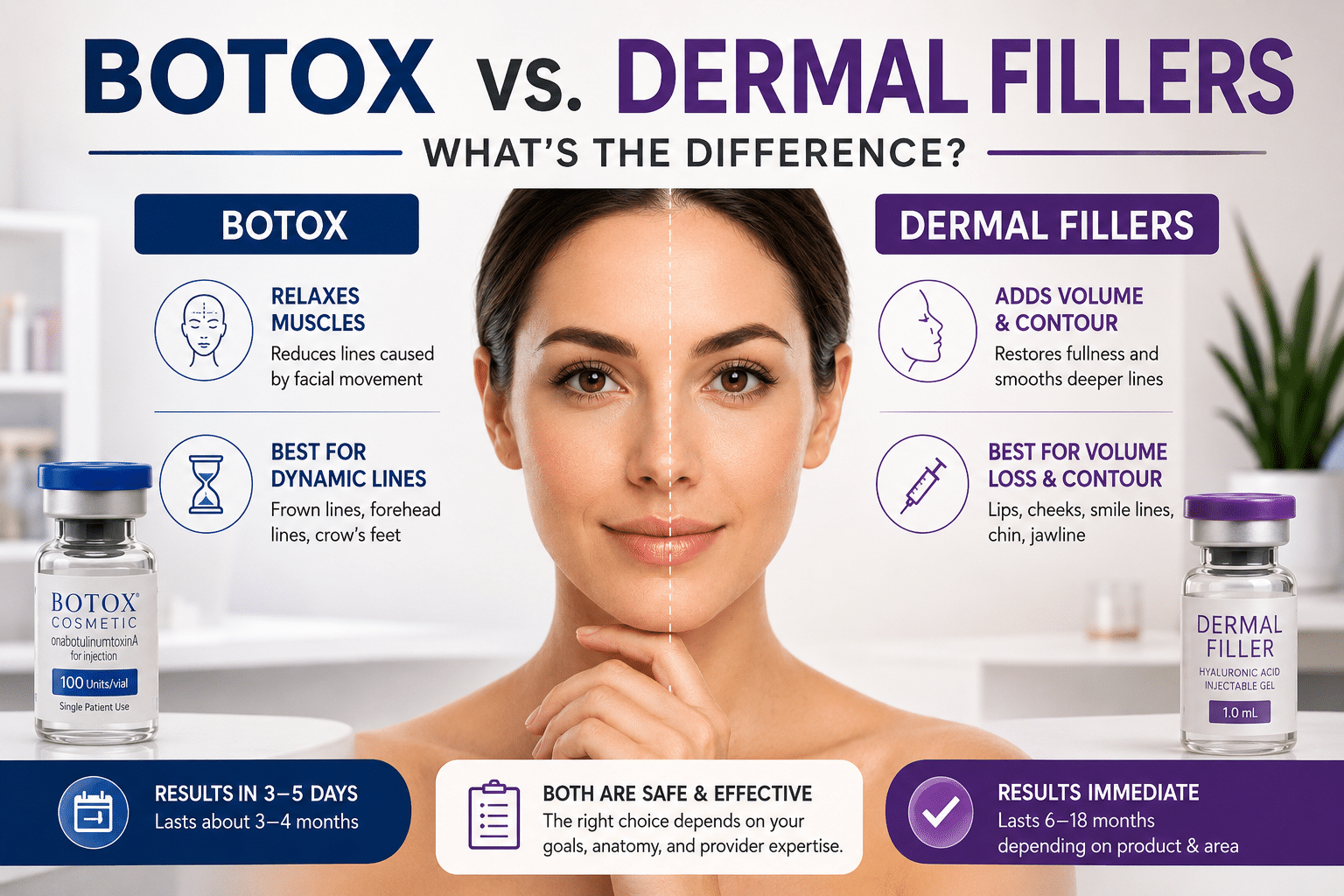
Botox and dermal fillers are both injectable cosmetic treatments, but they solve different problems.
Botox is usually used when repeated facial movement creates lines, such as frown lines, forehead wrinkles, or crow’s feet.
Dermal fillers are usually used when the face needs volume, support, or contour in areas such as the lips, cheeks, smile lines, chin, or jawline.
Botox vs Dermal Fillers: Quick Comparison
The easiest way to compare them is by the problem being treated.
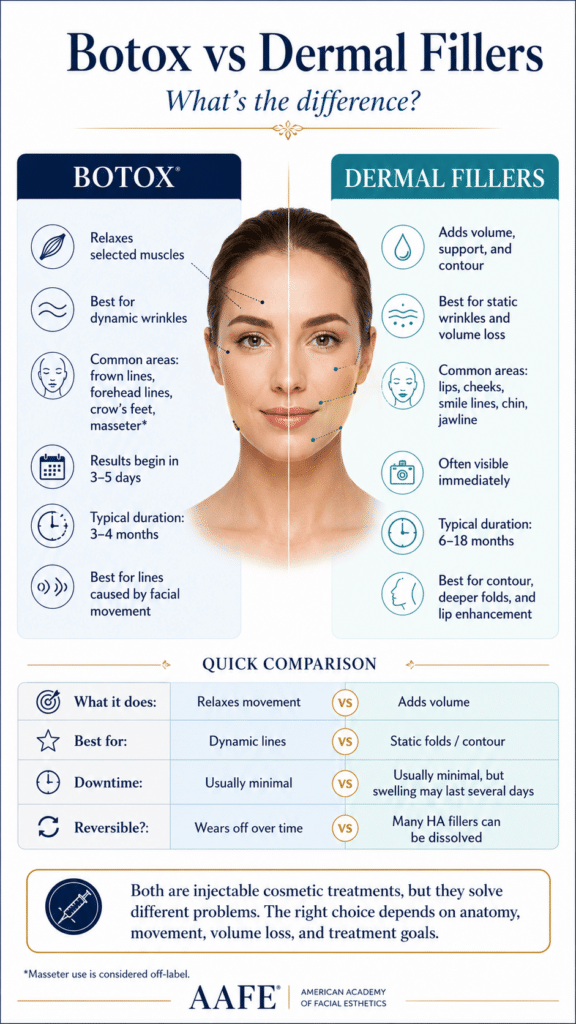
Botox is usually chosen for movement lines, while filler is usually chosen for lost volume, deeper folds, or contour changes.
| Factor | Botox | Dermal Fillers |
| What it does | Relaxes selected muscles | Adds volume, support, contour, or hydration |
| Best for | Dynamic wrinkles caused by facial expressions | Static wrinkles, folds, volume loss, lips, cheeks, chin |
| Common areas | Frown lines, forehead wrinkles, crow’s feet, masseter* | Lips, cheeks, nasolabial folds, marionette lines, jawline, chin |
| How it works | Temporarily reduces muscle contraction | Places gel or soft tissue fillers beneath the skin |
| Typical onset | 3 to 5 days for early change, up to 14 days for full Botox results | Often visible immediately, though swelling can blur the final look |
| Typical duration | Botox lasts about 3 to 4 months for many patients | Often 6 to 18 months, depending on product and area |
| Recovery/downtime | Usually minimal, with possible redness or bruising | Usually minimal, but swelling and tenderness can last several days |
| Reversible? | No quick reversal, but it wears off over time | Many hyaluronic acid fillers can be dissolved with hyaluronidase |
| Best-fit use case | Lines from muscle movement | Lost volume, deeper folds, contour, or lip enhancement |
*Using Botox for jaw tension, clenching, or TMJ-related muscle tightness (including the masseter) is considered an off-label use.
What Is Botox?
Botox is a brand name for botulinum toxin injections used to relax targeted facial muscles. In cosmetic use, a Botox injection is often used for frown lines, forehead wrinkles, crow’s feet, and other wrinkles caused by repeated movement.
Botox does not add volume to the face. It works by reducing the pull from specific muscles, so the skin above those muscles looks smoother.
What Are Dermal Fillers?
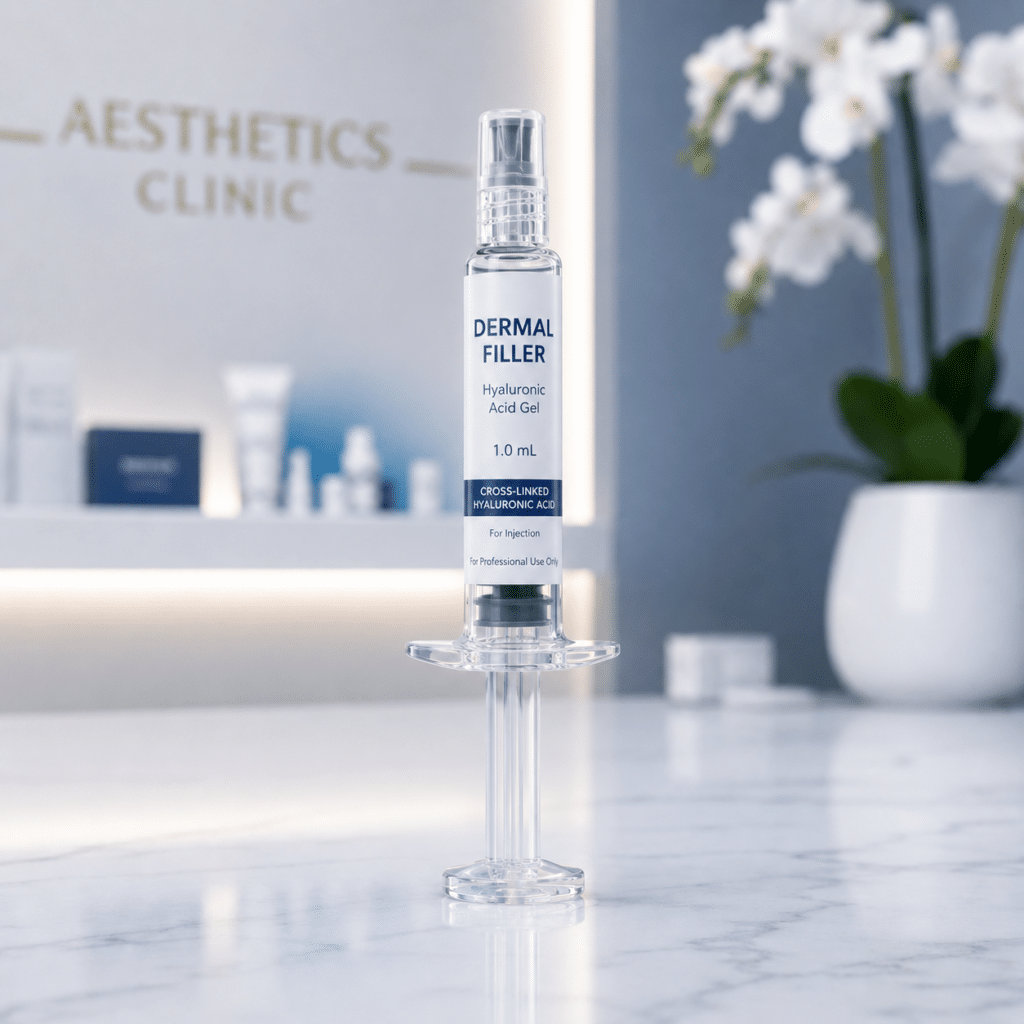
Dermal fillers are injectable products placed under the skin to restore volume, soften folds, support contour, or enhance lip shape.
The FDA describes dermal fillers, also called soft tissue fillers, as medical device implants approved for creating a smoother or fuller appearance in areas such as nasolabial folds, cheeks, chin, lips, and backs of the hands.
Most patients know hyaluronic acid fillers first, but filler options also include calcium hydroxylapatite, poly-L-lactic acid, and other products. Lactic acid-based biostimulatory fillers work differently from standard HA gels because they help build gradual support over time.
Main Differences Between Botox and Dermal Fillers
Botox vs fillers is not a brand debate. It is a diagnosis question. Providers need to decide whether the visible concern comes from muscle movement, volume loss, skin quality, tissue descent, or several issues together.
How They Work
Botox relaxes movement. If a patient frowns, raises the brows, or squints and the line becomes deeper, Botox treatments may fit.
Fillers add volume or support. Dermal filler injections can lift a cheek, define a jawline, smooth a fold, or restore lip shape. If the crease stays visible while the face is relaxed, filler may be more useful than Botox alone.
What They Treat
Botox is usually best for dynamic wrinkles, such as frown lines, crow’s feet, and forehead wrinkles. These lines are tied to repeated facial expressions.
Fillers are usually better for static wrinkles, facial folds, volume loss, and contour needs. Smile lines, thin lips, hollow cheeks, a recessed chin, and some jawline concerns often need filler planning.
How Fast Results Appear
Botox results take time because the muscle has to respond. Many patients notice softening in 3 to 5 days, with the strongest result near two weeks.
Filler results appear faster because volume is being placed immediately. Swelling can make lips or cheeks look fuller at first, so the final look should usually be judged after swelling settles.
How Long Results Last
Botox lasts about 3 to 4 months for many patients. Stronger muscles, high movement areas, dose, metabolism, and treatment consistency can change that timeline.
Filler longevity varies more. Lip filler may last closer to 6 to 12 months, while cheek or jawline filler may last 12 to 18 months or longer in some patients. Product type, injection depth, metabolism, and movement all matter.
Cost Differences
Botox is usually priced by unit. In many U.S. clinics, cosmetic Botox costs around $12 to $18 per unit, so a 20-unit frown line treatment may cost about $240 to $360. A broader upper-face plan using 40 units may land closer to $480 to $720.
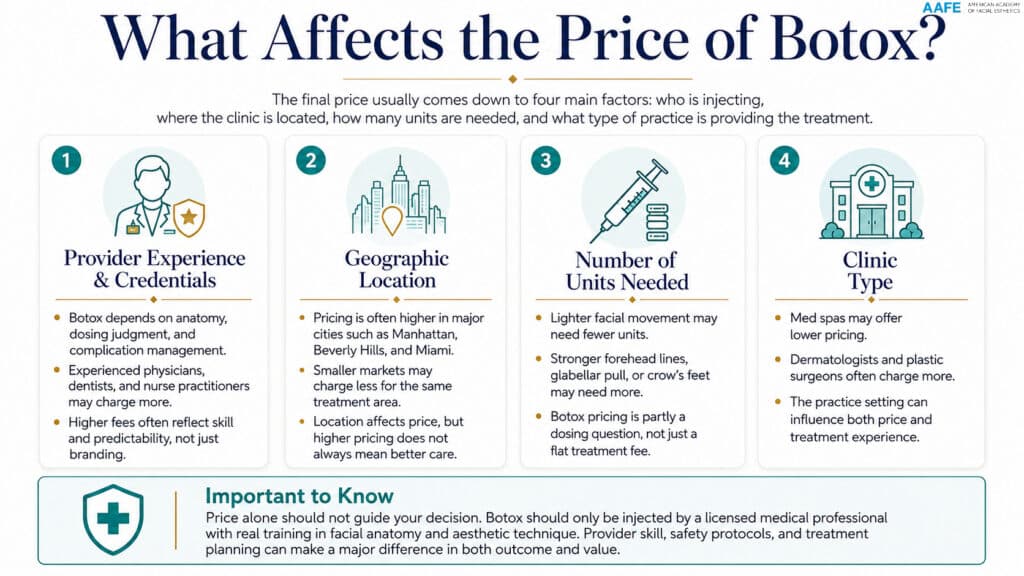
Fillers are usually priced by syringe, which changes the math. According to the American Society of Plastic Surgeons, the average cost of hyaluronic acid dermal fillers is $715, non-hyaluronic acid fillers is $901, and lip augmentation with dermal fillers is $743. A lip treatment may use part of one syringe or one syringe, while cheek or jawline work may need one to two syringes or more.
That is why filler often costs more per visit than Botox. Botox pricing rises with units. Fillers cost more when the treatment plan needs more product, deeper structural support, or a more complex treatment area.
Botox or Filler: Which Is Better for Each Concern?
The right choice depends on what is creating the visible change. A good consultation typically starts with movement, then considers volume, skin quality, and facial structure.
| Concern | Usually Better Option | Why |
| Forehead lines | Botox | These lines usually deepen when the frontalis muscle raises the brows. |
| Frown lines | Botox | The “11” lines come from corrugator and procerus muscle activity. |
| Crow’s feet | Botox | Squinting and smiling often drive lines around the outer eyes. |
| Thin lips | Filler | Filler can add volume, define borders, and enhance lip shape. |
| Cheek volume loss | Filler | Cheeks need support, lift, or contour, not muscle relaxation. |
| Smile lines | Often filler, sometimes combination planning | Folds may come from cheek volume loss, tissue movement, or skin changes. |
| Jawline contour | Filler or Botox | Filler can define structure, while Botox may help a bulky masseter. |
| TMJ, clenching, masseter tension | Botox may be discussed | Muscle relaxation may reduce clenching force, while filler does not treat tension. |
Can You Combine Botox and Dermal Fillers?
Yes, many treatment plans use Botox and dermal fillers together, but for different reasons.
- Botox can reduce movement that keeps folding the skin.
- Filler can restore support where volume loss has changed the shape of the face.
For example, a patient with frown lines and cheek volume loss may need Botox between the brows and filler in the midface.
A patient with thin lips and a gummy smile may need lip filler, Botox, or staged planning. Timing, sequencing, and dose should come from a qualified injector, not a package deal.
Safety, Side Effects, and Choosing the Right Provider
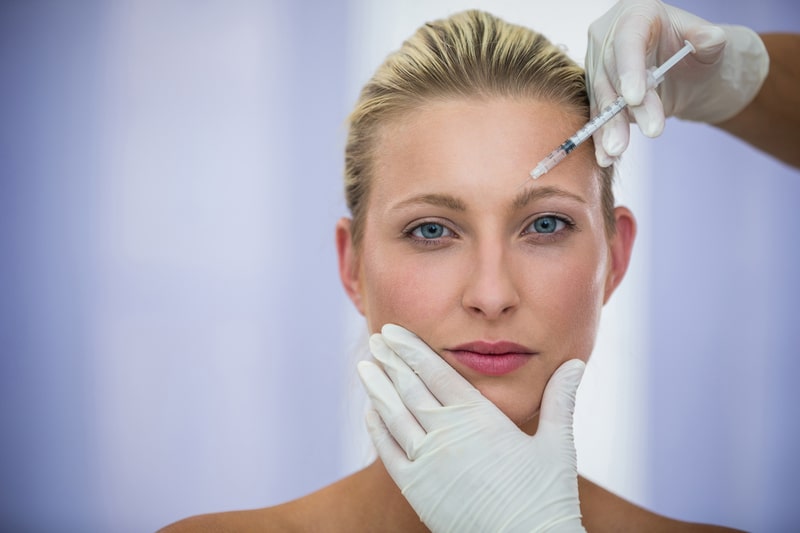
The biggest difference between a good and bad injectable result is often the assessment behind it. Product choice matters, but anatomy, placement, dose, and emergency planning matter more.
Possible issues:
- Bruising, swelling, and tenderness: Common after both cosmetic procedures, especially around lips and thin skin areas.
- Asymmetry or undercorrection: May happen when muscle pull, volume loss, or facial structure is misread.
- Overcorrection: Too much filler can look puffy, while too much Botox can cause a heavy or frozen look.
- Botox-specific side effects: Temporary weakness, brow heaviness, smile changes, or unwanted muscle effects can occur.
- Filler-specific risks: Lumps, migration, infection, allergic reaction, and vascular complications need proper training and protocols.
The FDA warns that unintended injection of filler into a blood vessel can cause blocked blood flow, tissue death, vision problems, blindness, stroke, or death. It also tells patients not to buy fillers online or inject themselves.
That is why FDA-approved products, proper sourcing, facial anatomy knowledge, and emergency protocols are essential.
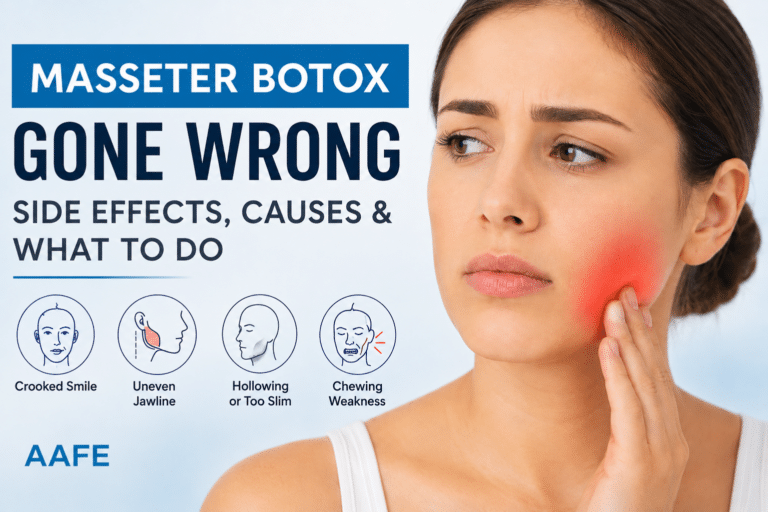
Read more: Masseter Botox Gone Wrong
Why Botox and Filler Training Matters for Providers
For dental and medical professionals, Botox and dermal filler treatments are separate clinical skills.
Botox requires understanding facial muscles, dosing, symmetry, muscle depth, and functional anatomy.
Fillers require knowledge of facial structure, vascular anatomy, product selection, injection depth, and complication management.
For dentists especially, this connects naturally to facial anatomy, occlusion, TMJ concerns, smile design, lips, lower-face balance, and patient esthetic goals.
The business case is practical too. ASPS reported 9,883,711 neuromodulator injection procedures and 5,331,426 HA filler procedures in 2024, showing strong demand for minimally invasive cosmetic treatment. AAFE has trained more than 18,000 dental and medical professionals in evidence-based injectable techniques since 2007.
For licensed professionals interested in adding injectables to their practice, AAFE’s Botulinum Toxins & Dermal Fillers Level I course covers patient assessment, anatomy, live patient care, dosing, dermal filler injections, adverse reactions, and practice integration.

Frequently Asked Questions
More Information
Reference: FDA Guidance on Dermal Fillers, Approved Uses, and Safety Risks
Reference: FDA Dermal Filler Do’s and Don’ts, Approved Uses, and Safety Guidance
FDA’s article on dermal filler dos and donts wrinkles lips and more
Reference: American Society of Plastic Surgeons 2024 Procedural Statistics and Aesthetic Trends Report