Summary
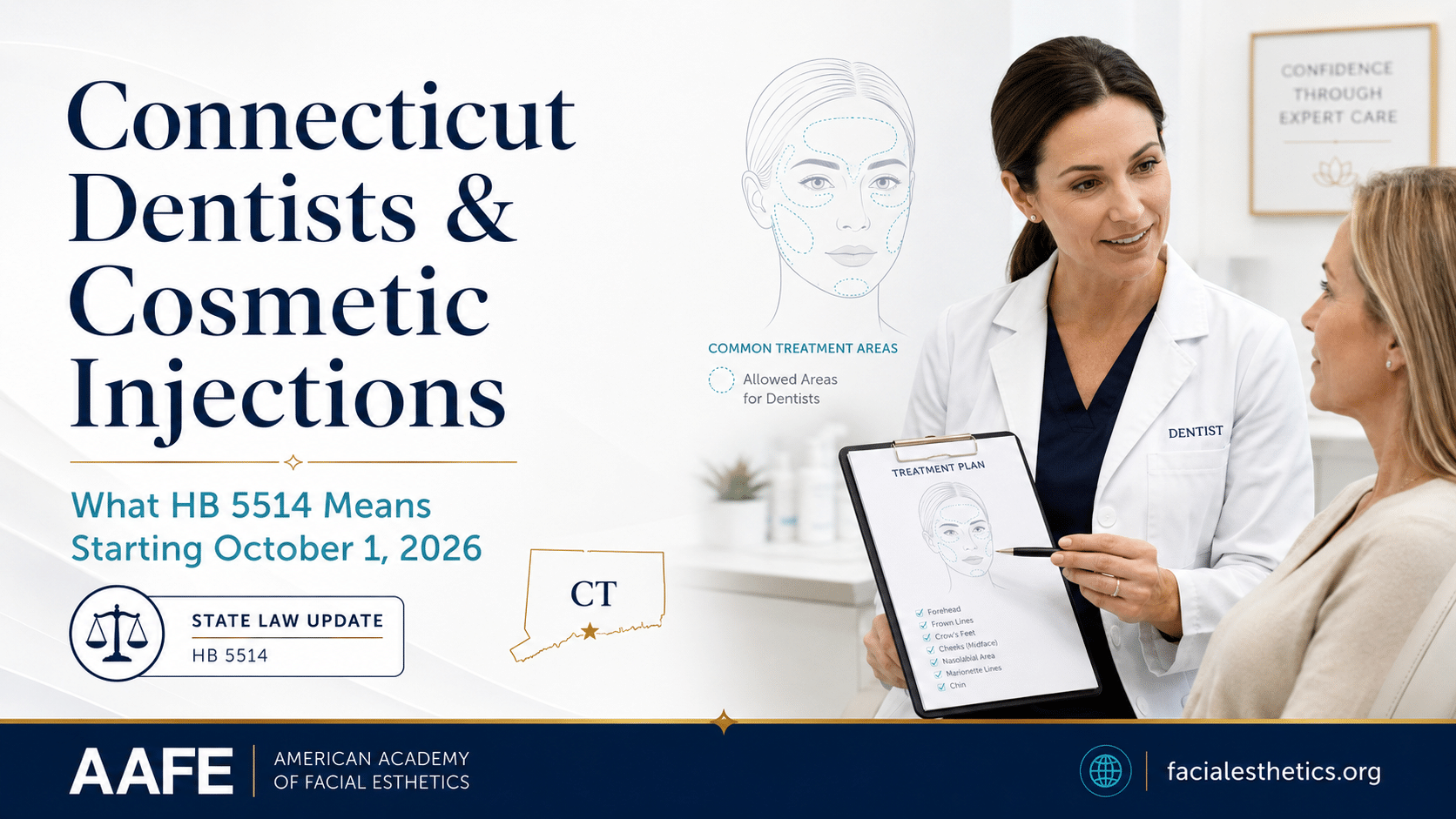
Starting October 1, 2026, Connecticut dentists may perform select cosmetic injections in specific facial areas under HB 5514. Dentists must complete hands-on training, carry appropriate liability insurance, and follow strict anatomical limits, safety protocols, and documentation requirements.
Connecticut dentists now have a new legal pathway to offer select cosmetic injection services. Governor Ned Lamont has signed House Bill 5514 into law, and the cosmetic injection provisions take effect October 1, 2026.
This is a major update for Connecticut dentistry, but it is also a tightly defined one. Dentists may perform cosmetic injections only in specific facial areas named in the statute. Before launch, practices should address in-person hands-on training, professional liability coverage, consent forms, documentation, patient safety protocols, and staff workflow.
What Does HB 5514 Allow Connecticut Dentists to Do?
HB 5514 allows Connecticut dentists to perform certain cosmetic injections within defined facial anatomical areas beginning October 1, 2026. The law does not allow dentists to inject every area of the face for cosmetic purposes.
The biggest practical change is that Connecticut dentists now have a clearer pathway into select facial esthetic services. The law allows some cosmetic injection areas, excludes others, and treats neuromodulators and dermal fillers differently around the lateral canthal region, commonly known as crow’s feet.
The new law, advocated for by the Connecticut State Dental Association (CDSA) and AAFE, also requires dentists to complete in-person hands-on training before performing cosmetic injections. Dentists must also maintain professional liability insurance that covers cosmetic injection procedures, so malpractice coverage should be confirmed before any launch plan moves forward.
Which Cosmetic Injection Areas Are Allowed?
| Area | What the Law Allows | Practical Meaning |
| Lateral canthal lines, or crow’s feet | Neuromodulators only | Neuromodulator treatment is permitted here, but dermal filler is not. |
| Nasolabial folds | Cosmetic injections allowed within statutory limits | Dentists need filler training and strong lower-face anatomy knowledge. |
| Lips | Cosmetic injections allowed within statutory limits | Lip filler requires vascular anatomy, product selection, and complication training. |
| Marionette lines | Cosmetic injections allowed within statutory limits | Treatment planning should consider lower-face balance and smile movement. |
| Chin | Cosmetic injections allowed within statutory limits | Dentists should understand mentalis activity, chin contour, and product choice. |
| Malar, zygomatic, or midface region | Dermal filler allowed when the primary site is cheek or midface and remains inferior to the infraorbital rim | Midface treatment is allowed only within the stated anatomical boundary. |
Which Injection Areas Are Not Allowed?
HB 5514 also names areas that dentists are not authorized to inject for specific cosmetic purposes.
The law does not authorize dentists to administer injections into the tear trough, infraorbital hollow, eyelids, medial canthal region, or other orbit-adjacent soft tissue for under-eye hollow correction or periocular volumization.
It also does not authorize injections into the forehead, glabella, or eyebrows for cosmetic enhancement purposes.
There is one detail Connecticut dentists should read carefully. Neuromodulators are allowed in the lateral canthal region for lateral canthal rhytids, but dermal fillers are not permitted in that region. In plain terms, Botox-type treatment may be allowed for crow’s feet, but filler is not.
What About TMD, Orofacial Pain, and Oromandibular Conditions?

HB 5514 also makes an important distinction for dentists treating pain-related conditions. The statute says the law does not prohibit injections for managing orofacial pain, temporomandibular disorders, or other oromandibular conditions.
That matters because these cases are different from cosmetic injection visits. A patient with jaw pain, clenching, masseter overuse, facial muscle pain, or TMJ symptoms needs a proper dental exam first. The provider should document symptoms, check jaw movement, palpate muscles, review bite forces, and explain what injections may or may not help.
For Connecticut dentists, this is one reason training should go beyond cosmetic placement. Our Frontline TMJ and Facial Pain Therapy Level I course helps dentists connect facial pain exams, trigger point therapy, muscle assessment, and treatment planning. For providers adding injectable care, our Botulinum Toxins & Dermal Fillers Level I course adds hands-on Botox training, anatomy, dosing, and live patient experience.
Hands-On Training Is Mandatory Before Cosmetic Injections
HB 5514 requires dentists to complete adequate hands-on training before performing cosmetic injections. This should be treated as a safety and compliance requirement, not a box to check before marketing.
Cosmetic injections require more than product knowledge. Training should include facial anatomy, patient assessment, product selection, injection technique, dosing, vascular risk, adverse-event planning, consent, documentation, and follow-up.
Video-only training does not build the same judgment needed for lips, nasolabial folds, chin, midface, or neuromodulator treatment near the eyes. Dentists need to understand both the allowed areas and the risks tied to each area.
Our Botulinum Toxins & Dermal Fillers Level I course gives dentists hands-on training in patient assessment, anatomy, dosing, live patient care, and practice integration. Dentists can also review our Level I course outline to see what foundational injectable training should include.
For providers who want deeper anatomy training, our Injection Anatomy, Inject and Dissect Cadaver Lab Training Course adds advanced anatomy, dissection, and injection safety context.
What Connecticut Dentists Should Do Before October 1, 2026

- Review the statutory anatomical limits and build a service menu around allowed areas.
- Confirm scope with legal counsel, the Connecticut Dental Commission, or other proper regulatory guidance.
- Complete in-person hands-on training before treating patients.
- Maintain professional liability insurance that covers cosmetic injection procedures.
- Do not delegate cosmetic injections to dental hygienists, dental assistants, or other auxiliary personnel.
- Watch for any future Department of Public Health rules on minimum training standards, approved courses, and patient safety requirements.
- Build consent forms, photography protocols, and treatment documentation templates.
- Create product protocols for sourcing, storage, lot tracking, expiration dates, and adverse events.
- Train front desk and clinical staff on what services can be discussed and scheduled.
- Start with a focused injectable menu instead of offering every possible service on day one.
AAFE Training for Connecticut Dentists
Connecticut dentists planning for October 1, 2026 should use this time to build a hands-on clinical foundation before offering cosmetic injections.
At the American Academy of Facial Esthetics, we train licensed dental and medical professionals to add facial esthetic and therapeutic services safely. Our courses focus on live patient training, facial anatomy, diagnosis, treatment planning, documentation, and real practice integration.
For Connecticut dentists, this timing matters because HB 5514 requires in-person hands-on training before cosmetic injections begin. It also gives practices a chance to build services the right way, instead of guessing through their first injectable appointments.
AAFE training options for Connecticut providers:
- Botulinum Toxins & Dermal Fillers Level I for hands-on Botox and filler training with live patient care.
- Frontline TMJ and Facial Pain Therapy Level I for dentists treating jaw pain, TMD, trigger points, and facial pain patterns.
- Injection Anatomy, Inject and Dissect Cadaver Lab Training for deeper anatomy training and injection safety.
AAFE is an ADA CERP Recognized Provider and an AGD PACE-approved provider. For Connecticut dentists, the next step is practical: train early, confirm malpractice coverage, build protocols, and launch only when your team is ready.
Ready to prepare your Connecticut team for HB 5514? Visit our Connecticut Botox and injectables training to request private training, check upcoming courses, or call 1-800-952-0521.

Frequently Asked Questions
More Information
Connecticut State Dental Association HB 5514 Legislative Summary