Summary
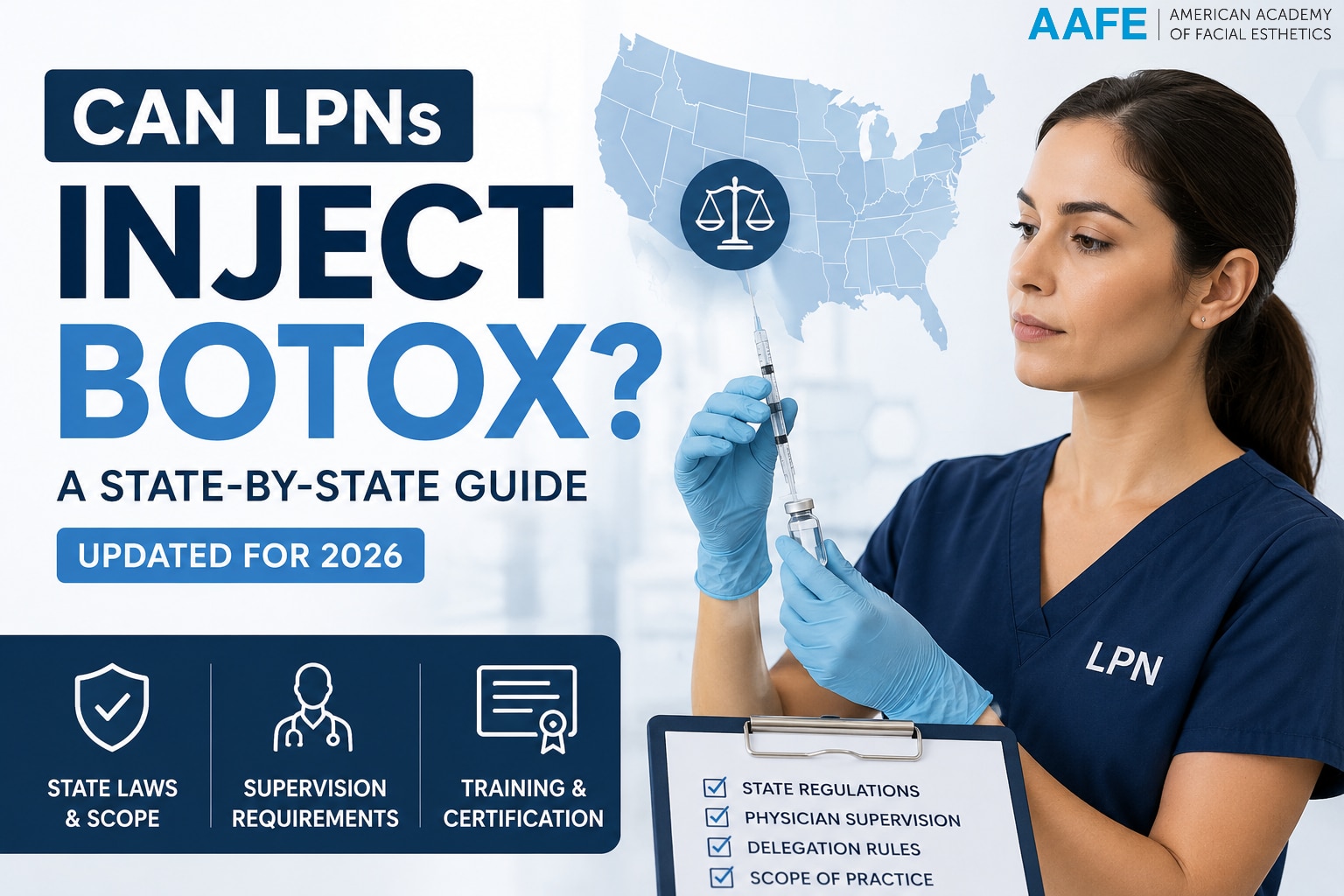
Most LPNs cannot inject Botox independently because it is a prescription medical procedure that requires patient assessment, an authorized treatment plan, and compliance with state scope-of-practice rules. Whether an LPN may participate depends on the state, delegation rules, supervision, employer policies, and malpractice coverage; some states allow trained LPNs to inject under qualified supervision, while others restrict Botox to higher-level licensed providers. Completing a Botox certification does not expand an LPN’s legal authority, so nurses should verify guidance from their nursing and medical boards before enrolling or treating patients. Where participation is permitted, hands-on training in facial anatomy, dosing, contraindications, injection safety, and complication management is essential.
Aesthetic medicine can offer LPNs a real career opening, especially for nurses who want more specialized clinical work. The schedule may be more predictable, the patient demand is steady, and Botox training can feel like a strong next step for nurses who want to grow beyond traditional care settings.
But can LPNs inject Botox legally?
The answer depends on the state, the procedure, the supervising provider, and the limits of the LPN’s scope of practice.
Quick Answer: Can LPNs Inject Botox?
Most LPNs cannot inject Botox independently. Botox is a prescription medical procedure, so LPN authority depends on state scope rules, delegation, supervision, employer policy, and malpractice coverage.
A few states give clearer permission. Kentucky allows a competent, appropriately trained LPN to administer neuromodulators under a qualified healthcare provider or RN supervision, and Washington allows trained LPNs to administer neuromodulators under required direction and prescription rules.
Other states are clearly more restrictive. California’s Medical Board names physicians, RNs, and PAs for Botox injection authority, while Georgia states that cosmetic neuromodulator injections are within RN scope and not LPN scope. For most states, the question is not solved by the LPN license alone.
What Is an LPN and What Is Their Scope of Practice?
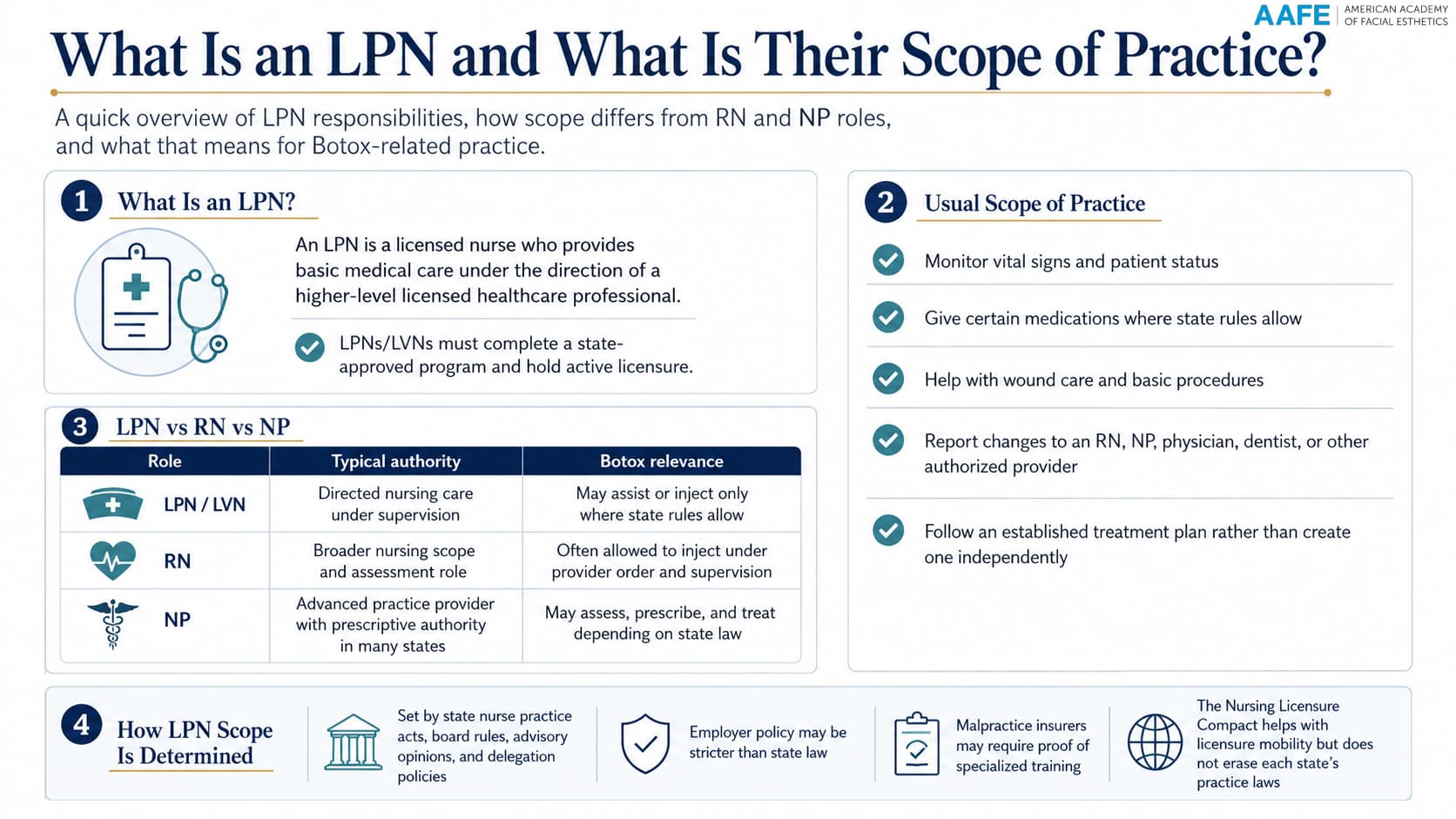
An LPN is a licensed nurse who provides basic medical care under the direction of a higher-level licensed healthcare professional.
The U.S. Bureau of Labor Statistics says LPNs and LVNs provide basic medical care, must complete a state-approved program, and must be licensed.
LPNs’ scope of practice usually includes:
- monitoring vital signs and patient status
- giving certain medications where state rules allow
- helping with wound care and basic procedures
- reporting changes to an RN, NP, physician, dentist, or other authorized provider
- following an established treatment plan rather than creating one independently
LPN vs RN vs NP: Key Differences
The main difference is assessment authority, independence, and who can build or approve the treatment plan. Botox is a prescription treatment, so those differences matter.
| Role | Typical authority | Botox relevance |
| LPN / LVN | Directed nursing care under supervision | May assist or inject only where state rules allow |
| RN | Broader nursing scope and assessment role | Often allowed to inject under provider’s order and supervision |
| NP | Advanced practice provider with prescriptive authority in many states | May assess, prescribe, and treat depending on state law |
How LPN Scope of Practice Is Determined
LPN scope of practice is set at the state level through nurse practice acts, board rules, advisory opinions, and delegation policies.
Employer policy can be stricter than state law, and malpractice insurers may also require proof of complete specialized training. The Nursing Licensure Compact helps with licensure mobility, but it does not erase each state’s practice laws.
Step-by-Step Guide for LPNs Interested in Botox Certification

The U.S. had about 651,400 LPNs and LVNs in 2024, and many are looking for ways to grow beyond traditional settings. Aesthetics can be a real path, but only if the legal and clinical steps are handled in the right order.
1. Confirm Your LPN License and State Scope of Practice
Before searching for Botox training programs, confirm that your LPN or LVN license is active and in good standing.
Then check whether your state allows LPNs to participate in aesthetic procedures at all.
Do not rely only on a course website or employer promise. Your state nursing board and medical board are the first places to check.
2. Check Whether Botox Can Be Delegated to LPNs in Your State
Botox is a prescription medical treatment, so LPNs do not create the treatment plan or decide who should receive it.
Where LPN participation is allowed, there is usually a valid prescriber order, patient assessment by an authorized provider, supervision requirements, written protocols, and documented competency.
3. Find a Reputable Botox and Aesthetics Training Program
If your state allows an LPN path, training is the next decision to take seriously. Look for a program built for licensed healthcare professionals, not a quick beauty course that only shows where to place a needle.
The right Botox certification should cover facial anatomy, patient assessment, dosing, contraindications, injection safety, post-treatment care, and how to avoid common complications.
Our Botulinum Toxins & Dermal Fillers Level I course fits that kind of training path because it combines clinical education with hands-on learning and live patient experience.
4. Complete Classroom Education and Hands-On Training
Good injectable training needs both theoretical knowledge and hands-on training.
Classroom work helps explain how botulinum toxin works, where to inject, and when not to treat.
Supervised practical work helps build the judgment needed to administer Botox injections safely.
5. Understand Certification vs. Legal Permission
A certificate shows that you completed a course. It does not expand your legal scope of practice.
Your authority to inject still depends on state law, board guidance, supervision rules, prescriber orders, employer policy, and whether Botox administration can legally be delegated to an LPN.
6. Work Under Proper Supervision Where Allowed
If Botox is allowed for LPNs in your state, confirm the supervision details before the first patient.
- Who performs the medical evaluation?
- Who orders the Botox?
- Who is responsible for the treatment plan?
- Who responds to complications?
Can an LPN Inject Botox Independently Without Supervision?
No. LPNs should not treat Botox as an independent service. Botox is a prescription drug and a medical aesthetic procedure.
Even in states where an LPN may inject, the work is tied to delegation, supervision, patient assessment, and a prescriber-approved treatment plan.
Independent Botox practice is a very different legal question from helping in a supervised medical practice.
Botox Certification Benefits for LPNs
Botox certification can still be valuable for LPNs, even when state law limits direct injection. Certification primarily builds a stronger path into aesthetic medicine.
- Better aesthetic knowledge: Training helps LPNs understand facial anatomy, product behavior, dosing logic, and ensure patient safety.
- Clearer career direction: Certification can help an LPN decide whether to stay in support roles, pursue RN licensure, or work in a supervised med spa setting.
- Stronger support skills: LPNs may help with intake, documentation, patient prep, aftercare, and follow-up where allowed.
- Safer team communication: Proper training helps LPNs understand what the injector, prescriber, and patient are discussing.
- Better employer fit: Aesthetic practices often value staff who understand treatment flow, contraindications, and post-treatment care.
Why Botox Rules Are Different for LPNs in Every State
There is no single national rule that says every LPN can or cannot inject Botox. Nursing practice is state-based, and cosmetic injections often involve both nursing laws and medical practice rules.
That is why one state can allow a trained LPN under delegation, while another state leaves the role to RNs, NPs, PAs, physicians, or dentists.
Why Botox Is Not Treated Like a Basic Injection
Because the goal is not simply to place medication under the skin. The provider must assess the patient, choose the dose, understand facial anatomy, inject the correct muscles, and manage possible adverse effects.
Can LPNs Inject Aesthetic Injections?

Sometimes, but the answer depends on the state, the procedure, and the supervision structure.
Botox, dermal fillers, and other aesthetic procedures are not all treated the same way. Fillers may carry an even higher risk because vascular compromise is possible.
If an LPN is allowed to participate in Botox, that does not automatically mean they can perform dermal filler injections, too.
What Should You Do Next?
- Check your state nursing board first. Confirm that cosmetic neuromodulator injections fit your LPN or LVN scope, not just general medication administration.
- Check your state medical board next. Botox is a prescription medical treatment, so physician delegation, patient evaluation, and supervision rules can change your legal path.
- Confirm malpractice coverage before injecting. Your employer’s policy may not protect you if Botox is outside your license, training, or written job role.
- Ask employers exactly what they require. Get clear answers on supervision, protocols, prescriber orders, charting, emergency plans, and accepted Botox certification.
- Choose hands-on training, not just online theory. LPNs need practical instruction in facial anatomy, dosing, safety, injection technique, contraindications, and complication response.
Get Botox Certification as an LPN from Facial Esthetics
If your state permits LPN participation in Botox, or you are building toward an aesthetics career, AAFE can help you train with the right foundation. We have trained over 18,000 healthcare professionals in facial esthetics, and our courses are taught by practicing clinicians who understand what it takes to bring these treatments into real medical, dental, and aesthetic settings.
Our trainings are built around the skills that matter before anyone picks up a syringe. You will study facial anatomy, patient assessment, treatment planning, botulinum toxin safety, dosing principles, injection technique, contraindications, consent, post-treatment care, and how to reduce avoidable complications.
The live patient training is especially important because Botox is not learned well from slides alone. You need to see how facial muscles move, how treatment plans change from patient to patient, and how experienced instructors think through real cases.
Ready to take the next step in aesthetics? Start your Botox certification with AAFE →

Frequently Asked Questions
More Information
Licensed Practical and Licensed Vocational Nurses
Official U.S. labor guidance covering LPN and LVN duties, work settings, education and licensing requirements, median pay, employment projections, and career outlook.
BLS career outlook for LPNs and LVNs
Nurse Licensure Compact
Official compact text covering multistate nursing licenses, eligibility requirements, interstate practice privileges, compliance with state practice laws, disciplinary authority, and information sharing between licensing boards.
Nurse Licensure Compact requirements and interstate practice