Summary
Botox syringe and needle selection can affect dosing accuracy, product waste, patient comfort, and injection control. Many injectors use 0.3cc or 0.5cc syringes with fine 30- to 33-gauge needles, but the best setup depends on the treatment area, reconstitution method, dose size, and injector preference. Clear markings, low dead space, a smooth plunger, reliable needle sharpness, and consistent clinic protocols are more important than simply choosing the smallest needle. Because dilution changes how units are read on the syringe, every vial should be properly labeled and documented to prevent dosing errors. Hands-on training helps providers connect syringe choice, reconstitution, anatomy, and injection technique within a safe, repeatable Botox workflow.
Most new injectors focus on where to place Botox. Experienced injectors also care about what is in their hand. Syringe size, needle gauge, dead space, and reconstitution all affect how cleanly each unit is measured, delivered, and documented.
Best Syringes and Needles That Are Commonly Used for Botox
Many injectors use a 0.3cc syringe or a 0.5cc syringe for Botox injections because they make tiny dose changes easier to control.
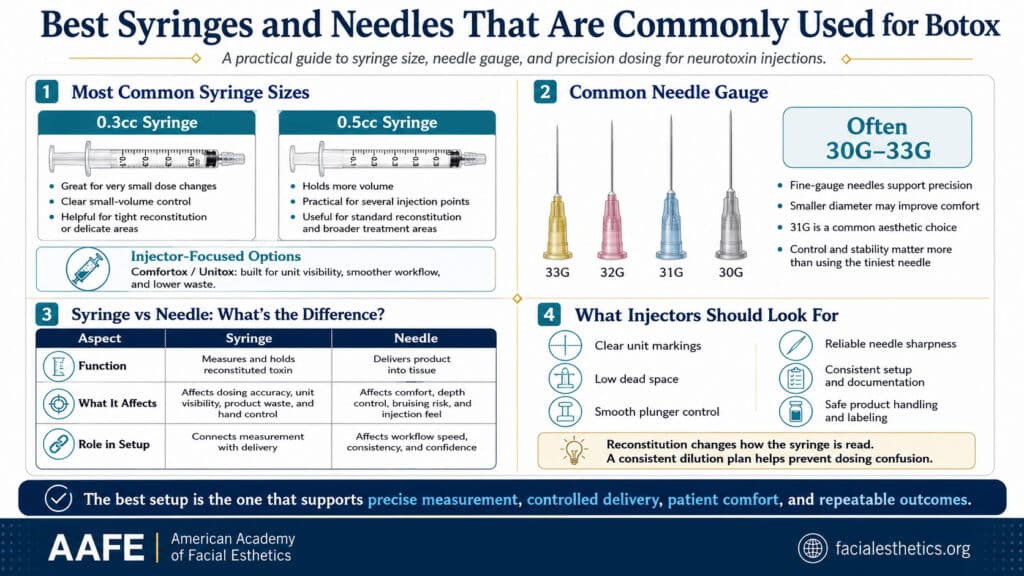
- A 0.3cc syringe can be helpful when the treatment uses very small amounts per injection point.
- A 0.5cc syringe may feel more practical when treating several areas from the same draw.
Needle choice usually centers on fine-gauge options, often around 30 gauge to 33 gauge. Thinner needles can support patient comfort, but the sharpness, stability, and feel of the needle matter too. The goal is not simply to choose the smallest needle, but to measure clearly, place the dose accurately, and keep each injection controlled.
Botox Syringes vs Botox Needles: What’s the Difference?
The syringe controls how much product you measure and deliver. The needle affects entry, comfort, depth control, and how smoothly the product is injected.
| Tool | Main Role | What It Affects |
| Syringe | Holds and measures reconstituted botulinum toxin | Accurate dosing, unit visibility, product waste, hand control |
| Needle | Enters the tissue and delivers product | Patient comfort, depth control, bruising risk, injection feel |
| Needle-syringe setup | Connects measurement with delivery | Workflow speed, consistency, confidence, and product handling |
0.3cc vs 0.5cc Syringes for Botox
Both syringe sizes can work, but they are not equally useful in every setup. The reconstitution plan often decides which one feels easier in the hand.
| Syringe Size | Practical Use | Why Injectors Choose It |
| 0.3cc syringe | Often useful for tight reconstituted neurotoxin or smaller-dose work | Shorter barrel, clear small-volume control, easier reading for tiny unit changes |
| 0.5cc syringe | Often useful for standard reconstitution and broader treatment areas | Holds more volume, works well when several injection points are planned |
| Insulin syringe | Sometimes used because markings are familiar and fine | Must match the dilution exactly, or dosing confusion can happen quickly |
| Unitox syringes or Comfortox syringes | Injector-focused options used by some aesthetic clinicians | Built around unit visibility, low waste, and smoother neurotoxin workflow |
What Needle Gauge Is Commonly Used for Botox Injections?
Botox needle size should support precision without making the injection uncomfortable.

Draw properly reconstituted toxin into a sterile syringe, preferably a tuberculin syringe, then attach a 30 to 33 gauge needle for administration.
Many injectors use fine-gauge needles because a smaller needle diameter may support patient comfort.
A 31 gauge needle is common in aesthetic medicine, while some skilled injectors use specific needles, such as TSK invisible needles for fine-detail work. Selection still depends on treatment area, tissue thickness, hand control, and training.
Thinner does not automatically mean better. Very fine needles can feel more flexible, so a skilled injector needs steady hand control and clear depth judgment.
How Reconstitution Affects Syringe Choice
Reconstitution changes how many Botox units are in each tenth of a milliliter. That directly changes how the injector reads the syringe.
The Botox Cosmetic label lists a standard cosmetic reconstitution of 4 units per 0.1 mL. It also states that Botox units are specific to that product and cannot be converted into units of other botulinum toxin products. That matters because dilution, dose measurement, and product handling must stay consistent.
If the clinic changes dilution, the team must change how they read the syringe. A mark that equals 4 units under one dilution may equal a different dose under another. This is where mistakes happen, especially when multiple providers share a room, tray, or treatment schedule.
Good workflow includes labeling the vial, documenting reconstitution time, recording lot number, using consistent medical supplies, and keeping the same dose map across repeat visits.
Comfortox Syringes: Why Some Injectors Prefer Them

Comfortox syringes are one example of a Botox syringe built around small-dose control. Some injectors prefer them because the markings are easy to read, the plunger feels smooth, and the low dead space design can help reduce wasted product.
They are not the only option. Unitox syringes, insulin syringe designs, and other standard syringes can also work when they match the injector’s dilution plan and hand control.
What Injectors Should Look For in Botox Syringes and Needles
A Botox syringe should help the injector stay precise under real clinical conditions. If the markings are hard to read, the plunger sticks, or the dead space is high, the setup can quietly affect consistency.
Look for:
- Clear unit markings: The syringe should match the clinic’s reconstitution and avoid mental math during treatment.
- Low dead space: Less leftover product in the hub can reduce waste across busy neurotoxin days.
- Smooth plunger control: A jumpy plunger makes tiny dose changes harder to deliver cleanly.
- Reliable needles: Needle sharpness affects patient discomfort, tissue drag, and bruising risk.
- Consistent setup: Switching between products, syringes, and dilution styles can confuse documentation.
- Treatment-area fit: A broad masseter pattern and delicate glabellar work may not feel best with the same setup.
- Safe product handling: Reconstituted toxin should be labeled, stored, timed, inspected, and documented.
The best Botox needles are not just the finest needles. They are the needles that help the provider inject Botox with control, comfort, and repeatable outcomes.
Learning Botox Tools in Hands-On Training
Syringes and needles are easier to understand when providers use them on real treatment plans. Reading about dilution helps, but holding the syringe, watching product movement, and connecting dose to muscle response is different.
AAFE’s Botulinum Toxins & Dermal Fillers Level I course includes patient assessment, facial anatomy, proper preparation, dilution, dosing, live patient care, and practice integration.
Providers who want deeper anatomy training can also explore AAFE’s Injection Anatomy, Inject and Dissect Cadaver Lab Training Course, especially if they plan to grow beyond entry-level neurotoxin treatments.
For injectors, the goal is not to memorize one tool setup forever. The goal is to understand why the tool works, when to adjust it, and how to administer Botox safely within a repeatable protocol.

Frequently Asked Questions
More Information
STERiJECT The Invisible Needle
Product overview covering the ultra-thin 35G toxin needle, near-painless injections, minimal bleeding, low dead-space technology, reduced product waste, secure hub connection, and leakage prevention.
Invisible Needle features for botulinum toxin injections
BOTOX Cosmetic Prescribing Information
Historical FDA-approved labeling covering onabotulinumtoxinA formulation, dosing and administration, contraindications, adverse reactions, and the boxed warning about the distant spread of toxin effects. This 2009 document may not reflect the latest FDA-approved labeling.