Summary
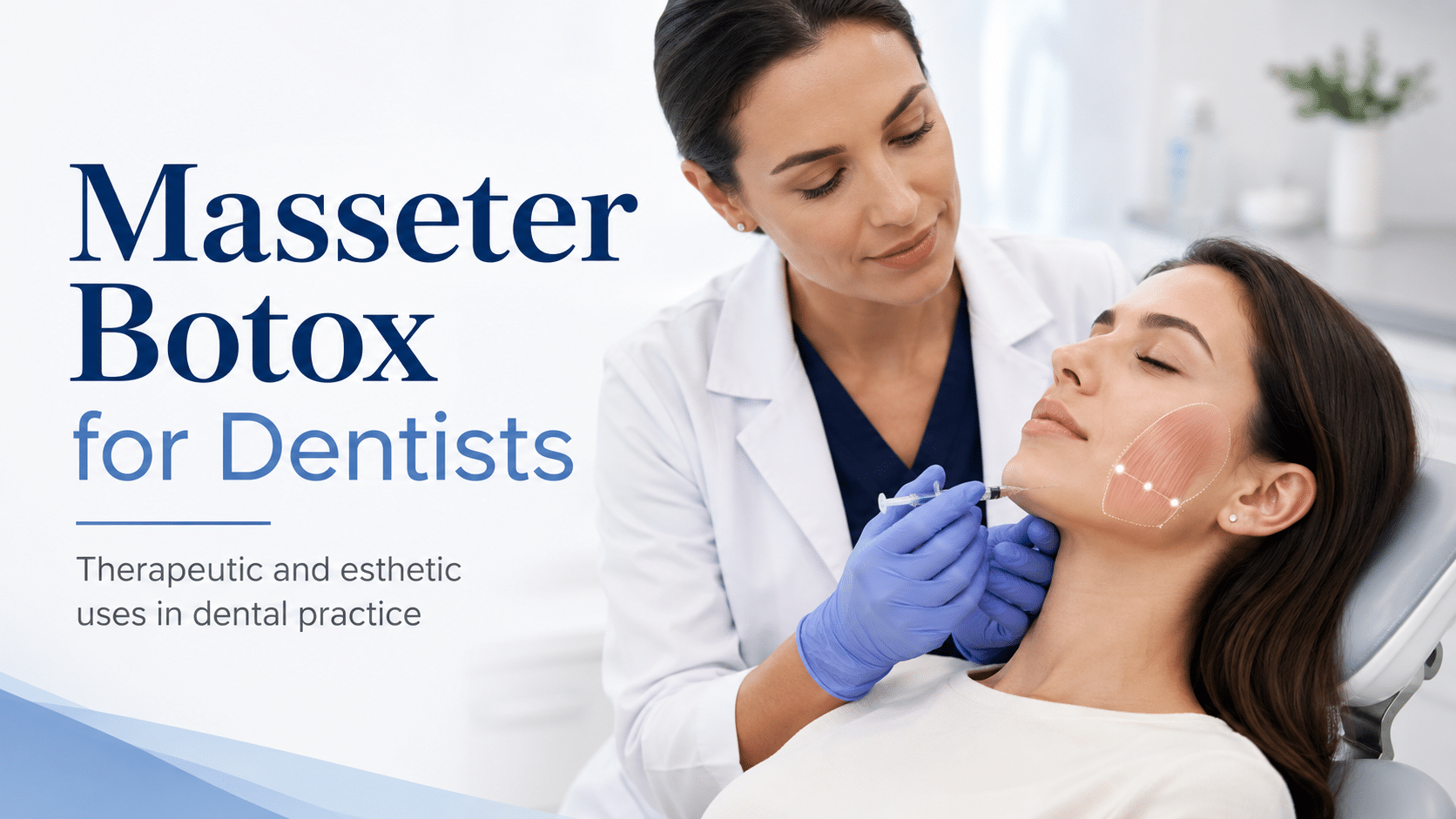
Masseter Botox can give dentists an additional way to manage selected cases of bruxism, jaw clenching, muscular TMJ symptoms, facial pain, masseter enlargement, and muscle-driven jawline width. It temporarily reduces masseter activity but does not protect teeth, correct joint disease, change bone structure, or address airway and sleep-related causes, so it should remain part of a broader diagnostic and treatment plan. Good candidates show clear muscle overactivity or hypertrophy, while results usually develop gradually over several weeks and fade over the following months. Dentists must confirm state scope, liability coverage, and off-label consent requirements and complete hands-on training in anatomy, patient selection, dosing, injection technique, documentation, and complication management before offering treatment.
Your patients are already in the chair, talking about clenching, morning soreness, headaches, worn teeth, or a wider jawline. The real question is whether they receive masseter Botox from you or find another qualified provider.
You already examine how the jaw moves, where the muscles are overworking, and what the teeth are showing you. Masseter Botox provides another option for selected concerns while keeping diagnosis and dental health central to patient care.
This AAFE guide explains where masseter Botox for dentists fits, who may benefit, what results to expect, and how to integrate it responsibly.
What Is Masseter Botox?
Masseter Botox involves injecting botulinum toxin into one of the main muscles responsible for closing and clenching the jaw. Botox produces a localized reduction in muscle activity, temporarily lowering contraction strength in the treated area [1].
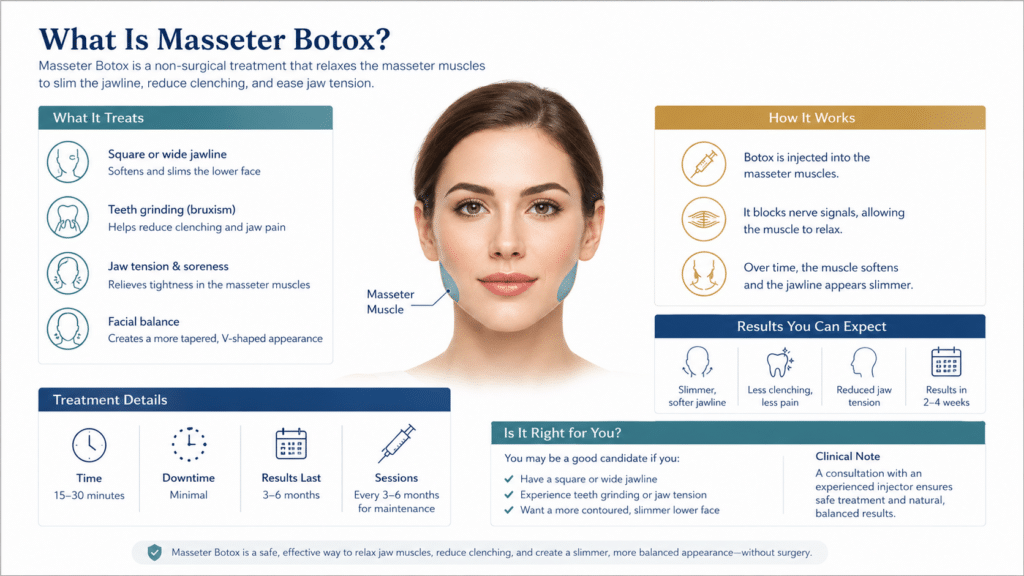
Dentists may consider Botox for overactive or enlarged masseters linked with bruxism (teeth grinding), chronic jaw tension, facial pain, or masseter hypertrophy (enlarged jaw muscles). Reduced muscle activity may also create gradual changes in lower-face width.
The treatment is non-surgical and can be completed during an in-office appointment after a suitable clinical assessment.
AAFE also explains how masseter Botox works, including its mechanism, possible risks, and the patient experience.
Off-label note: No botulinum toxin product is currently FDA-approved specifically for masseter injection [1]. Clinical research has examined bruxism, muscle pain, TMD symptoms, masseter hypertrophy, and jawline contouring, although the strength of evidence varies [2][3][4][5].
Why Dentists Are Natural Providers for Masseter Botox
Dentists already examine the structures that influence masseter Botox treatment. A routine dental assessment may reveal flattened cusps, fractured restorations, tooth sensitivity, enlarged jaw muscles, limited opening, or tenderness during palpation.
That clinical view matters because persistent jaw pain does not always come from the same source. The temporomandibular joint, masseter muscles, temporalis muscles, sleep bruxism, daytime teeth clenching, and referred pain can produce similar complaints.
The dental setting is also ready for this type of care. Practices already have clinical lighting, adjustable chairs, medical histories, consent systems, photography, sterilization protocols, and scheduled follow-up.
A qualified dentist can connect dental health with facial balance while keeping diagnosis central to the treatment plan.
Two Main Uses of Masseter Botox in Dentistry
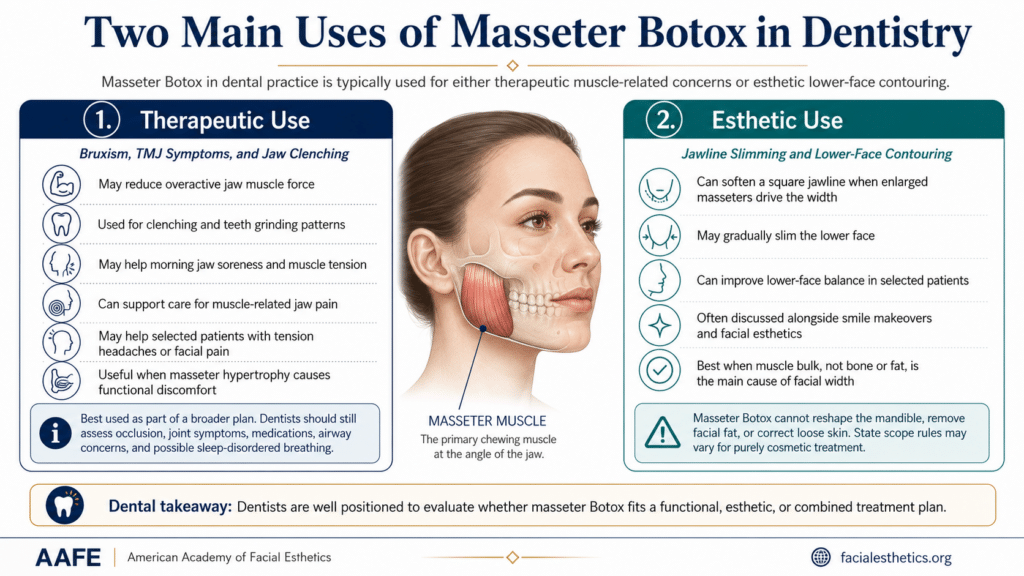
#1. Therapeutic Use: Bruxism, TMJ Symptoms, and Jaw Clenching
Therapeutic masseter Botox may be considered when overactive jaw muscles remain troublesome after appropriate conservative dental care. It can support a wider plan when a night guard protects the teeth, but muscle-related symptoms continue.
- Teeth grinding and jaw clenching: Research suggests botulinum toxin may temporarily reduce biting force and pain severity in selected adults with bruxism. However, effects vary and gradually diminish over time [2].
- Sleep bruxism and morning soreness: Some patients still wake with tired jaw muscles despite wearing a properly fitted mouth guard. Reviewing dental sleep and bruxism concerns can reveal airway risks or sleep-related causes requiring separate attention.
- Muscle-related jaw pain: Treatment may help selected patients when palpation, jaw movement, and symptom patterns point toward an overworked masseter. One prospective study involving 42 patients reported lower pain scores, fewer referred-pain episodes, and reduced analgesic use after treatment [3].
- Tension headaches and facial pain: Some patients with tender chewing muscles may improve when their headaches are connected with muscular tension. Evidence remains limited, so dentists should avoid treating every headache as a masseter problem [3].
- Masseter hypertrophy: Long-term muscle overuse can enlarge the masseters, creating functional discomfort, visible lower-face width, or both concerns together.
Botox should not replace a complete assessment or appropriate conservative care. Dentists still need to review occlusion, joint symptoms, medications, airway concerns, and possible sleep-disordered breathing. This approach is especially important with bruxism because tooth protection and muscle control address different parts of the problem.
#2. Esthetic Use: Jawline Slimming and Lower-Face Contouring
Esthetic masseter Botox works best when enlarged muscles create most of the patient’s lower-face width. Botox cannot reshape the mandible, remove facial fat, or correct loose skin.
One small trial involving 26 women found reduced masseter prominence after treatment. However, researchers also recorded reduced masticatory performance and warned about possible harm from repeated injections [4].
- Square jawline: Botox may gradually soften a square jawline when enlarged masseter muscles create most of its visible width [4].
- Jawline slimming: Reduced muscle activity may make the lower face appear narrower as the treated masseter gradually loses some bulk [4].
- Lower-face balance: Dentists can consider how the jaw, chin, lips, and smile work together before recommending cosmetic treatment.
- Smile makeover patients: Patients planning veneers, whitening, or restorative treatment may also ask about their overall facial balance.
Dentists already assess bite force, occlusion, jaw movement, and surrounding oral structures. This experience helps distinguish masseter hypertrophy from width caused by bone, facial fat, or skin laxity.
Scope note: Purely cosmetic masseter treatment is more scope-contested than therapeutic dental use. Some state dental boards require treatment to relate directly to a dental or functional condition. Confirm your board’s current position before offering masseter Botox solely for jawline contouring.
Which Dental Patients Are Good Candidates?
The best candidates have clear signs that an overactive or enlarged masseter is driving their symptoms or lower-face width.
| Stronger candidates | Poor candidates |
| Chronic grinding or clenching with clear muscle activity | Fullness caused mainly by bone, fat, or skin laxity |
| Morning soreness, jaw fatigue, or muscle tenderness | Unrealistic expectations about facial shape or pain relief |
| Worn enamel or damaged restorations linked with clenching | Certain neuromuscular conditions or active infection |
| Persistent symptoms despite a properly fitted night guard | Pregnancy or breastfeeding |
| Tension headaches connected with jaw muscle activity | Suspected sleep-disordered breathing needing evaluation |
| Visible masseter hypertrophy during clenching | Symptoms suggesting joint disease or another pain source |
| Patients requesting jawline slimming with true muscle bulk | Patients unwilling to accept temporary results or follow-up |
| Cosmetic dentistry patients discussing facial balance |
Every consultation should separate muscle pain from joint pain and cosmetic goals from functional concerns.
What the Masseter Botox Procedure Looks Like in a Dental Practice
A masseter Botox appointment can fit into an established dental workflow without a major equipment purchase.
- Review the history: Ask about medical conditions, medications, past Botox treatments, swallowing issues, and previous reactions.
- Clarify symptoms: Document teeth grinding, headaches, jaw pain, sleep concerns, morning soreness, and previous conservative care.
- Assess the bite: Look for tooth wear, fractured restorations, occlusal changes, cheek trauma, and signs of excessive bite force.
- Examine the muscle: Palpate each side during rest and clenching to compare strength, borders, tenderness, and asymmetry.
- Define the goal: Confirm whether treatment targets pain relief, reduced clenching force, jawline slimming, or combined concerns.
- Complete consent: Document the off-label application and explain realistic outcomes, temporary weakness, asymmetry, chewing changes, possible complications, and follow-up expectations [1][4].
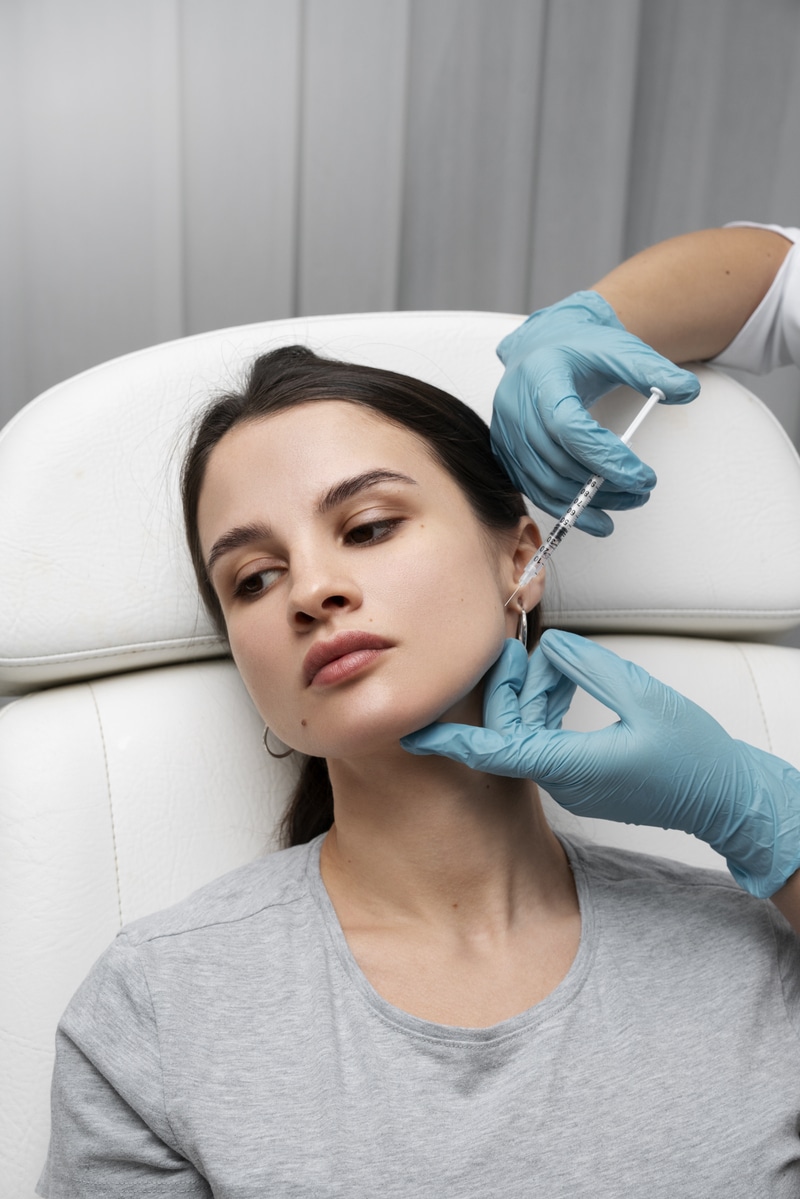
- Provide treatment: Botox injections are placed according to the product, anatomy, muscle size, and trained clinical judgment.
- Schedule follow-up: Reassess symptoms, muscle response, facial balance, and possible adverse effects according to the clinical protocol.
Safe masseter Botox injection planning requires anatomy knowledge beyond locating the largest visible muscle bulge. Detailed documentation matters whenever Botox is used for bruxism, TMJ pain, or other dental conditions.
Masseter Botox Results: What Dentists Should Tell Patients
Functional and esthetic outcomes follow different timelines. Bruxism research reports changes within four weeks, with stronger effects between weeks five and eight. Visible masseter changes usually develop more gradually.
Results are easiest to understand through real examples, and our masseter Botox before-and-after photos show how the lower face changes over time.
| Possible Therapeutic results | Possible Esthetic results |
| Reduced jaw tension | Slimmer lower face |
| Less clenching intensity | Softer jawline |
| Less morning soreness | Reduced square-jaw appearance |
| Fewer muscle-related headaches for some patients | Gradual change when masseter hypertrophy causes the width |
| Better comfort when used within a broader treatment plan | More balanced lower-face proportions in suitable patients |
Here is a more evidence-aligned timeline:
- Within four weeks: Changes in biting force, jaw tension, or muscle-related pain may become noticeable [2].
- Five to eight weeks: Therapeutic effects may become clearer, although patient response varies considerably [2].
- One to three months: Changes in masseter thickness and lower-face prominence may become easier to assess [4].
- Over the following months: Muscle activity gradually returns, and therapeutic or esthetic effects begin fading [2][4].
- Up to six months: Some effects may remain, although evidence does not support promising the same duration for every patient [2][4].
The Practice Opportunity for Dentists
Some of your dental patients already leave the office and pay another provider for Botox treatment. Masseter Botox gives you a natural reason to keep that care connected to the dental work you already provide.

The conversation may begin with a bruxism patient whose night guard protects the teeth but does not stop jaw pain. It may come from a TMJ patient with overactive masseter muscles, a veneer patient thinking about facial balance, or a cosmetic patient asking why the jawline looks wider.
These are existing patients with concerns that already overlap with general dentistry, oral health, and facial esthetics. A Botox appointment can also fit around established consultation, photography, consent, treatment, and follow-up systems without major equipment changes.
Because the effects gradually fade, suitable patients may return for reassessment and possible maintenance treatment [2][4]. Timing should follow clinical response rather than an automatic schedule. Offering masseter Botox within a dental practice can support continuity of care when every maintenance visit begins with reassessment.
Do Dentists Need Training to Offer Masseter Botox?
Yes. A DDS or DMD degree alone does not establish competency or legal authority for every Botox treatment. Dental school gives you a strong understanding of the jaw, occlusion, and oral health, but masseter Botox requires added clinical training. Offering Dental Botox means knowing how to select the right patient, plan the dose, place Botox injections safely, and respond when results do not follow the expected pattern.
The goal is not to memorize several injection points and begin treating. Dentists need to understand facial anatomy, masseter muscle depth, asymmetry, contraindications, consent, documentation, and possible complications. They also need to recognize when jaw pain comes from another dental condition that Botox therapy will not solve.
Legal permission is a separate issue. Each dental board decides whether Botox for dentists falls within its state scope of practice, whether treatment must relate to dentistry, and what education may be required. Review the current state requirements for Botox and confirm coverage with your liability carrier before adding Botox treatment. Completing training and earning a dental Botox certificate can show preparation, but certification never expands state scope.
Online lessons can teach dosing concepts, patient selection, and botulinum toxin safety. Hands-on training adds what a screen cannot: palpating a live masseter, seeing facial movement, controlling the injection, and adjusting the treatment plan with an instructor beside you.
Add Masseter Botox to Your Dental Practice With AAFE
Adding masseter Botox becomes less intimidating when education reflects the clinical decisions dentists face inside their own operatories.
AAFE teaches dentists to assess facial movement, recognize muscular pain patterns, plan treatment, document off-label care, and prepare for possible complications. Small-group, live-patient instruction lets dentists examine real anatomy and perform supervised injections with experienced faculty present.
Since 2007, AAFE has trained more than 22,000 dental professionals through anatomically based education at over 50 locations nationwide. AAFE is also an ADA CERP Recognized Provider and an AGD PACE Approved Provider.
The Botulinum Toxins and Dermal Fillers Level I course provides the clinical foundation for patient assessment, facial anatomy, treatment planning, injection technique, and complication management.
Find a Botox Training Course Near You

Frequently Asked Questions
More Information
- BOTOX Cosmetic Prescribing Information
The official product label covering approved indications, contraindications, warnings, adverse reactions, anatomy requirements, and risks involving unapproved uses.
FDA prescribing information for BOTOX Cosmetic - Effectiveness of Botulinum Toxin Injection on Bruxism
A systematic review and meta-analysis examining biting force, pain severity, treatment duration, oral splints, placebo injections, and adverse effects.
Botulinum toxin treatment for bruxism research - The Efficiency of Botulinum Toxin Type A for the Treatment of Masseter Muscle Pain
A prospective 42-patient study examining masseter pain, temporomandibular dysfunction, tension-type headaches, pain scores, and analgesic use.
Botulinum toxin for masseter pain and tension headaches - Exploring Botulinum Toxin’s Impact on Masseter Hypertrophy
A randomized clinical trial following muscle thickness, electrical activity, masseter prominence, and chewing performance for six months.
Botulinum toxin treatment for masseter hypertrophy - Temporomandibular Disorders
Official government guidance covering TMD diagnosis, conservative care, botulinum toxin evidence, and patient safety.
NIDCR guidance on temporomandibular disorders