Summary
Botox for TMJ-related pain is usually injected into overactive chewing muscles, especially the masseter and sometimes the temporalis, rather than directly into the joint. Proper treatment depends on identifying whether symptoms come from muscle tension, joint problems, or both. While Botox may reduce clenching, grinding, jaw fatigue, and muscle-related pain, it cannot repair arthritis, disc damage, locking, or other structural issues. Because incorrect placement can cause chewing weakness, facial asymmetry, or poor results, treatment should be performed by a licensed provider with advanced facial anatomy and TMJ training as part of a broader care plan.
A patient who clenches through a night guard, wakes with jaw pain, and points to the masseter is asking for more than quick pain relief.
Knowing where to inject Botox for TMJ starts with one decision: is the problem mainly joint-based, muscle-based, or both?
Where Is Botox Injected for TMJ?
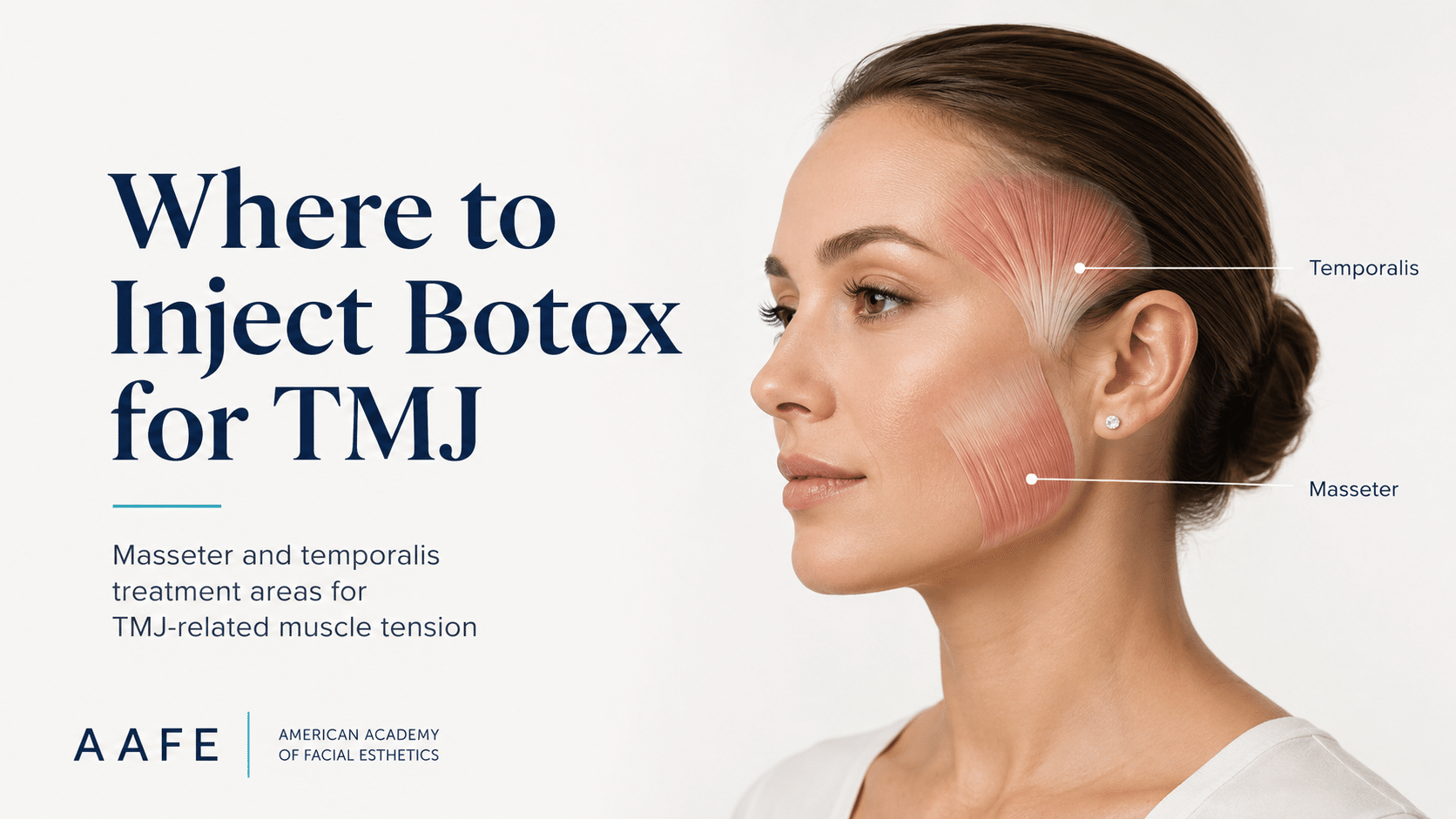
Botox for TMJ is usually injected into overactive jaw muscles, not directly into the temporomandibular joint. The most common target is the masseter muscle, the strong chewing muscle along the side of the jaw.
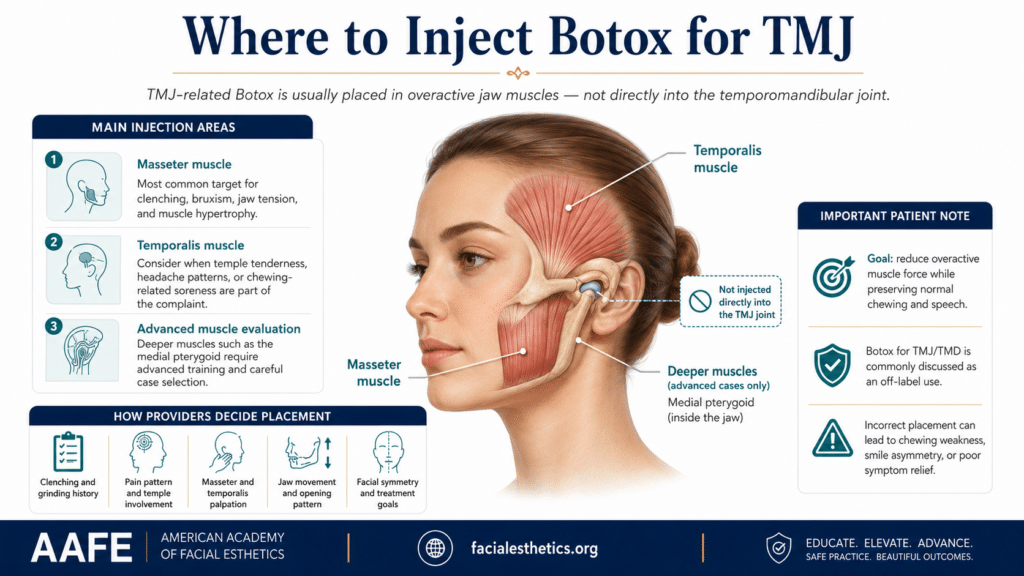
Some cases also involve the temporalis muscle at the temples, especially when TMJ symptoms overlap with temple tension, headaches, or myofascial pain. More complex muscles, such as the medial pterygoid, require advanced training and careful case selection.
Why TMJ Botox Targets Muscles, Not Just the Joint
The temporomandibular joint is the hinge joint, but many painful TMD cases involve the muscles that move the jaw. NIDCR explains that temporomandibular disorders include joint disorders, masticatory muscle disorders, and headaches linked with TMD. It also notes that about 11 to 12 million U.S. adults have pain near the temporomandibular joint.
So, using Botox for muscle relaxation may reduce forces from clenching or teeth grinding, but it will not repair a disc problem, arthritis, or structural joint damage. A strong TMJ treatment plan starts with diagnosis, not the syringe.
Main Injection Areas Used for TMJ-Related Symptoms
TMJ Botox planning should begin with muscle function, pain pattern, and jaw movement. The goal is not to “freeze the jaw,” but to reduce overactive muscle force while preserving normal chewing, speech, and facial balance.
Masseter Muscle
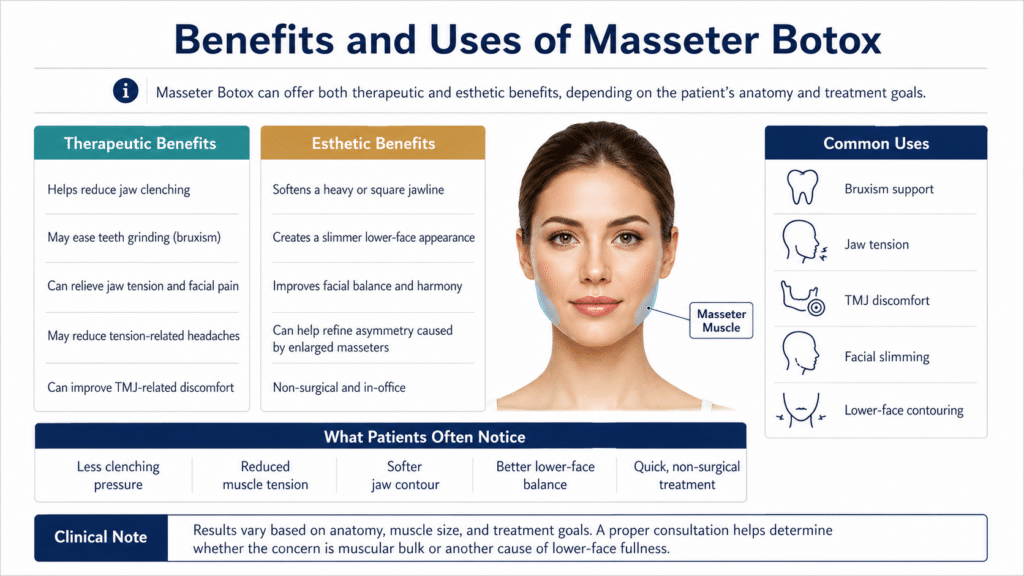
The masseter muscle is the large chewing muscle at the side of the jaw. Ask the patient to clench, and you can often feel it tighten under your fingers.
This muscle is commonly involved in clenching, bruxism, jaw tension, muscle hypertrophy, and a square-jaw appearance. It is usually the first muscle evaluated because it connects directly to bite force, worn teeth, cracked restorations, morning soreness, and patient-reported jaw fatigue.
Masseter treatment usually needs more units than small upper-face Botox areas because the muscle is larger and built for chewing force. Stronger clenching, larger masseters, or TMJ-focused cases may require a higher dose because greater muscle mass and force demand more product to achieve adequate relaxation.
Temporalis Muscle
The temporalis muscle sits at the temple and helps close the jaw during chewing. It can be easy to miss if the provider only checks the lower face.
Temporalis involvement may show up as temple tenderness, tension-type headache patterns, pain when chewing, or soreness after heavy clenching. A patient may say, “My jaw hurts,” but the painful trigger may include the temple, scalp, ear area, or side of the head.
Compare right and left sides, ask about headache timing, and check whether pain rises during chewing or after nighttime clenching. If the temporalis is part of the pattern, treating only the masseter may leave symptoms behind.
Other Muscles a Provider May Evaluate
Some TMJ or myofascial pain cases involve deeper jaw muscles, including the medial pterygoid. These muscles are not entry-level targets for casual treatment.
The medial pterygoid helps close the jaw and sits deeper than the masseter. Evaluating it requires stronger anatomical knowledge, safer technique, and a clear reason to include it.
Advanced cases may also require referral, imaging, or a broader pain management plan. Jaw locking, limited opening, neurologic symptoms, trauma history, or suspected joint pathology should not be treated as simple masseter tension.
How Providers Decide Where to Place Botox for TMJ
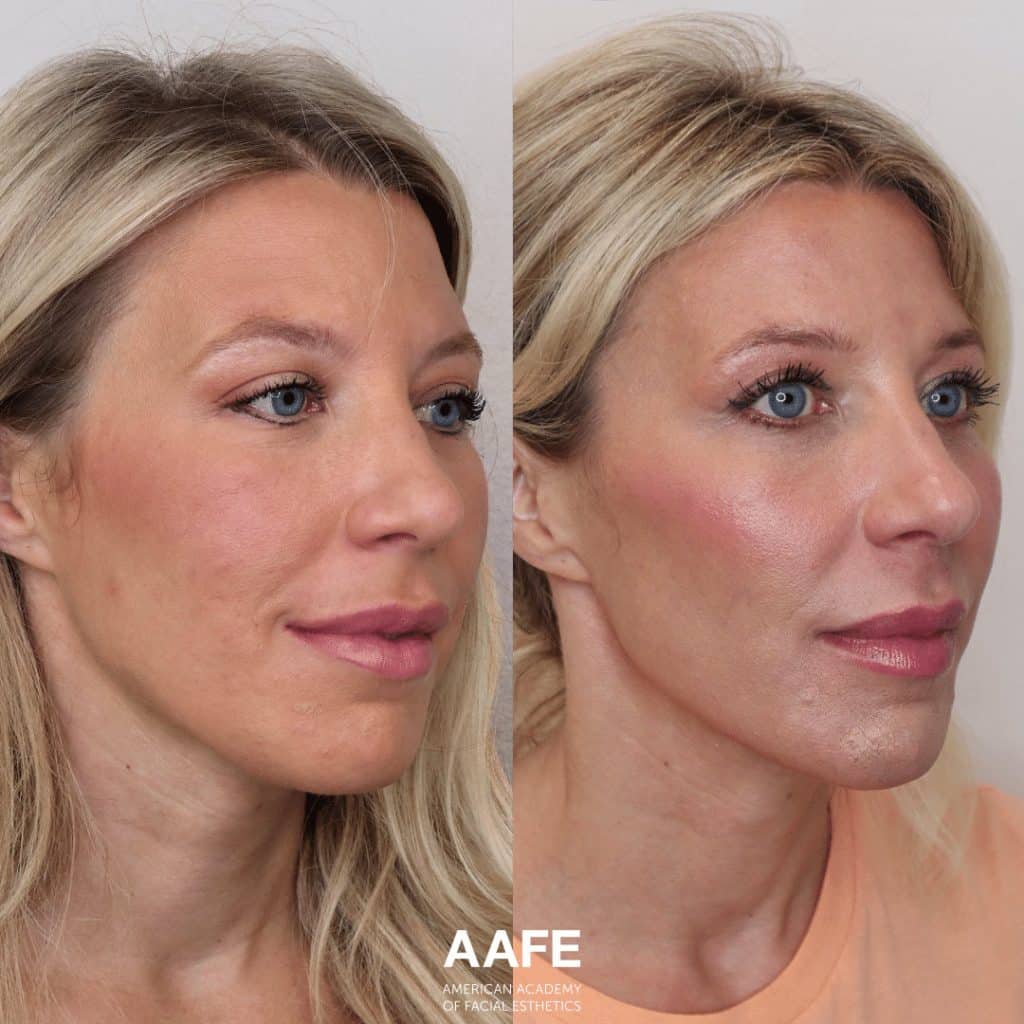
A good Botox injection plan for TMJ-related symptoms starts before the vial is opened. The provider should review clenching history, teeth grinding patterns, pain location, headache or temple involvement, bite changes, jaw movement, and prior appliance use.
The exam should include palpation of the masseter and temporalis, range of motion, opening pattern, joint sounds, facial symmetry, and esthetic impact. Medical history matters too, including neuromuscular disease, pregnancy status, medication use, allergy history, and prior botulinum toxin response.
What Patients Should Know Before Getting Botox for TMJ
Patients often hear “Botox for TMJ” and think it works directly on the joint. In most cases, the goal is different. The provider is usually trying to calm overactive jaw muscles that add pressure, soreness, or fatigue around the jaw.
Botox for TMJ or TMD is commonly discussed as an off-label use. That matters because patients should understand what the treatment can and cannot do before they start. It may help reduce muscle tension from clenching or teeth grinding, but it will not fix every source of jaw pain, jaw locking, arthritis, disc problems, or bite-related issues.
Even NIDCR notes that botulinum toxin type A is FDA-approved for some medical conditions, such as migraine, but not for TMD, and evidence for TMD symptom relief remains limited.
A good treatment plan often includes more than the Botox injection itself. Some patients still need a night guard, physical therapy, warm compress use, dental evaluation, habit changes, or referral for joint-focused care. Results are also temporary, so follow-up matters if symptoms return.
Before treatment, patients should ask what product is being used, who is injecting, how the provider chose the target muscles, what side effects to watch for, and when to call if chewing feels weak or uneven.
Risks of Incorrect Botox Placement for TMJ
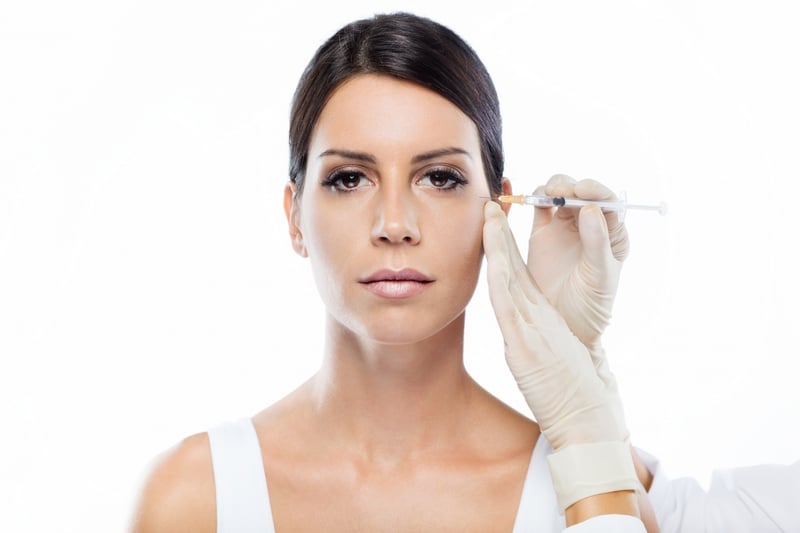
Incorrect placement can turn a useful therapeutic option into a patient-management problem. The most important risks to watch out for:
- Smile asymmetry: Product placed too far forward or into nearby expression muscles can alter lower-face movement.
- Chewing weakness: Excess relaxation of the masseter can make chewing tough foods feel tiring.
- Facial imbalance: Treating one side too strongly may change jawline symmetry or muscle balance.
- Normal jaw-function problems: Overweakening may affect chewing comfort, bite feel, or daily function.
- Bruising, soreness, or swelling: These are common injection-site side effects, but should still be discussed.
- Poor results from wrong targeting: If joint pathology is driving pain, muscle-only treatment may disappoint.
There is also a product-safety issue. Botulinum toxin is derived from Clostridium botulinum, the organism linked with botulism. The CDC reported 22 U.S. cases in 2024 involving adverse effects after counterfeit or mishandled botulinum toxin injections, with 11 hospitalizations. So, botulinum toxin should be given only by licensed, trained providers using FDA-approved products in appropriate healthcare settings.
Why TMJ Botox Requires Facial Anatomy Training
TMJ Botox is not just a cosmetic injection placed in a strong jaw muscle. It requires understanding dental anatomy, occlusion, masticatory muscles, facial balance, patient screening, documentation, and risk management.
This is one reason dentists have a natural advantage when trained properly. They already evaluate bruxism, worn enamel, fractured restorations, occlusal changes, jaw movement, and orofacial pain patterns. With the right training, Botox treatment can become a practical extension of existing care, rather than a disconnected add-on service.
Our guide for dentists offering masseter Botox explains where this treatment fits within bruxism, muscular TMJ symptoms, facial pain, jawline concerns, and responsible dental-practice integration.
AAFE’s Frontline TMJ and Facial Pain Therapy Level I course helps providers connect diagnosis, trigger point therapy, myofascial pain, facial pain therapy, and TMJ care. Providers adding injectables can also explore AAFE Botox training.

Frequently Asked Questions
More Information
Reference: CDC Health Advisory on Counterfeit or Mishandled Botulinum Toxin Injections
Adverse Effects Linked to Counterfeit or Mishandled Botulinum Toxin Injections
Reference: NIH Guidance on Temporomandibular Disorders, Diagnosis, and Treatment