
Summary
Masseter Botox usually begins affecting muscle activity within several days, with reduced clenching, jaw tension, or morning soreness becoming easier to notice within about one to two weeks. Visible jaw slimming takes longer because the masseter must gradually lose bulk, often beginning around weeks four to six and becoming clearest between weeks six and twelve. Results commonly last about three to four months, although some patients maintain benefits for up to six months. Functional relief and cosmetic slimming should be judged on different timelines, and results depend on muscle size, dose, placement, clenching severity, metabolism, and whether an overactive masseter is actually causing the patient’s symptoms or lower-face width.
Masseter Botox can begin affecting muscle activity within several days, although early changes are usually felt rather than seen.
Jaw tension and clenching may ease within one to two weeks, depending on the patient and treatment plan. Visible slimming often begins around weeks four to six, then becomes clearest between weeks six and twelve.
So, how long does masseter Botox take to work for your goal, and when should you judge the final result?
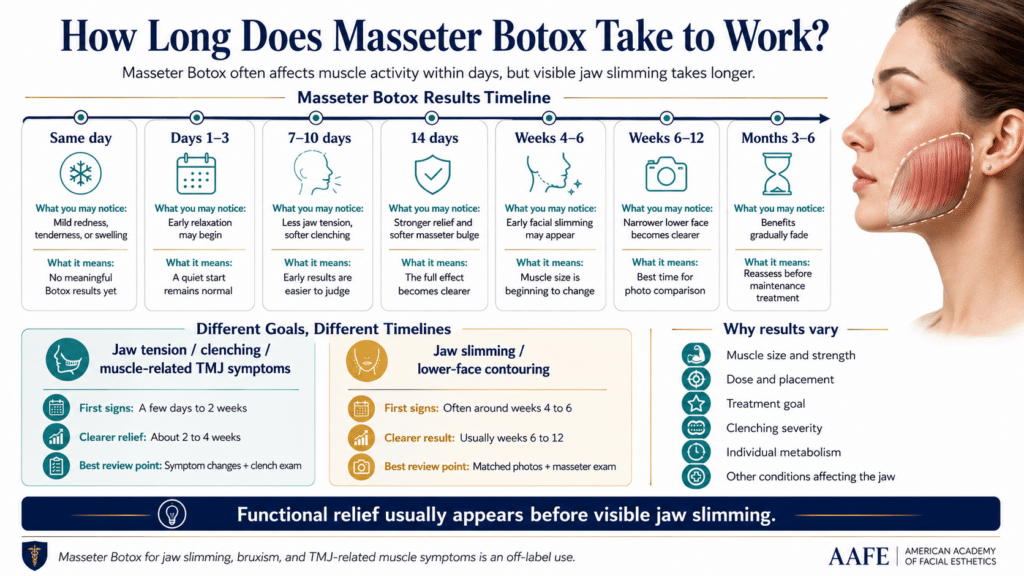
Masseter Botox Results Timeline at a Glance
Before you receive masseter Botox, separate what you may feel from what you expect to see.
| Time After Treatment | What You May Notice | What It Means |
| Same day | Mild redness, tenderness, or swelling | No meaningful Botox results yet |
| Days 1 to 3 | Early relaxation may begin, although many patients feel nothing | A quiet start remains normal |
| 7-10 days | Less jaw tension, softer clenching, or lower chewing force | Early results are easier to judge |
| 14 days | Stronger relief and a softer masseter bulge | The full effect becomes clearer |
| Weeks 4 to 6 | Early facial slimming may become noticeable | Muscle size is beginning to change |
| Weeks 6 to 12 | A narrower lower face may become clearer | Compare matched photographs during this period |
| Months 3 to 6 | Benefits fade as nerve signals return | Reassess before maintenance treatment |
No botulinum toxin product is currently FDA-approved specifically for injection into the masseter muscle. The jaw slimming, bruxism (teeth grinding), and temporomandibular joint (TMJ)-related uses discussed here are all off-label applications.
Why Masseter Botox Does Not Work Immediately
Botox takes time because botulinum toxin must enter nerve endings and reduce the signal causing contraction. Botox begins changing those signals after injection, then strengthens as more nerve endings become affected. That is how Botox works in a treated muscle.
The masseter is a powerful chewing muscle used throughout the day. Therefore, reduced contraction usually appears before any slimming effect from gradual muscle volume loss.
When Will Jaw Tension, Clenching, or TMJ Symptoms Improve?
Most patients notice less jaw tension within 7 to 14 days, although subtle relief sometimes begins after a few days. In correctly selected muscular cases, Botox helps reduce clenching intensity, morning soreness, facial tightness, and muscle-related tension headaches.
Masseter Botox does not relieve every source of jaw pain. Joint disease, dental problems, airway issues, and referred pain require separate care. Botox for bruxism may help when overactive jaw muscles drive clenching, while TMJ treatments should always match the actual cause.
Follow-up can also show whether reduced tension matches a measurable change in nighttime grinding. One documented case from AAFE President Dr. Louis Malcmacher followed a patient whose BEI measured well above 8.0 before treatment. Two weeks later, her BEI measured 0.6, although this single result should not be treated as typical.
When Will Jaw Slimming Results Show?
Visible jaw slimming often begins around weeks 4 to 6, then becomes clearer between weeks 6 and 12. Feeling the muscle relax and seeing the jawline slim follow different timelines.
This cosmetic procedure works best when lower-face width comes from large, overactive masseter muscles. Bone structure, facial fat, or loose skin will not shrink after a Botox treatment, so the visible results may remain limited.
Masseter Botox Week-by-Week: What to Expect
Immediately After Treatment
Your face should look unchanged, apart from temporary redness, tenderness, swelling, or small injection bumps. Follow provider guidance, including staying upright for at least 4 hours and avoiding massage or exercise for 24 hours.
Days 1 to 3
Botox starts affecting nerve signals, but many patients still feel the same. Unchanged shape does not mean the dose administered failed.
Week 1
Between 7-10 days, clenching may feel softer and morning tightness may ease. Chewing force can feel lower, while cosmetic change remains subtle.
Weeks 2 to 4
By 2 weeks, providers can compare relaxation and symmetry during clenching. A follow-up appointment may review symptoms, chewing comfort, and remaining strength.
Weeks 4 to 12
Early facial slimming may appear around weeks four to six as the relaxed masseter gradually loses bulk. The change often becomes clearer between weeks six and twelve, especially when the starting muscle was larger or stronger.
Month 3 and Beyond
By month three, results are settled enough for comparison. Effects fade gradually, although repeated treatments may produce longer visible changes.
Why Some People See Results Faster Than Others
- Muscle size and strength: Larger muscles need more time before volume loss becomes obvious.
- Dose: Product choice and dose affect onset, duration, and chewing comfort.
- Goal: Functional relief appears sooner than jawline slimming.
- Clenching severity: Strong daytime clenchers keep working the treated area.
- Individual metabolism: Faster onset can also mean faster fading.
- Treatment history: First-time patients may change more slowly after treatment.
- Placement: Accurate masseter Botox injections protect nearby smile muscles.
- Other conditions: An effective treatment plan must account for sleep bruxism, TMJ dysfunction, airway problems, and dental disease.
How Long Does Masseter Botox Last?
Most masseter Botox results last about 3 to 4 months, although some patients maintain benefits for 4 to 6 months. Therapeutic relief and cosmetic slimming may fade at different rates as nerve signals and muscle use return.
Strong clenchers may need reassessment sooner, while some patients maintain visible facial slimming for up to six months. Future masseter Botox treatments should follow examination and patient response, rather than a calendar.
How to Know If Masseter Botox Is Working
Do not judge one selfie or one stressful morning. Look for several changes developing together over time:
- Less jaw tightness during the day
- Less soreness after waking
- Reduced jaw clenching or teeth grinding intensity
- Fewer tension headaches when those headaches were muscle-related
- A softer masseter bulge when you bite down
- Gradual jaw slimming across matched photographs
- A less square lower face when masseter hypertrophy (enlarged jaw muscles) caused the width
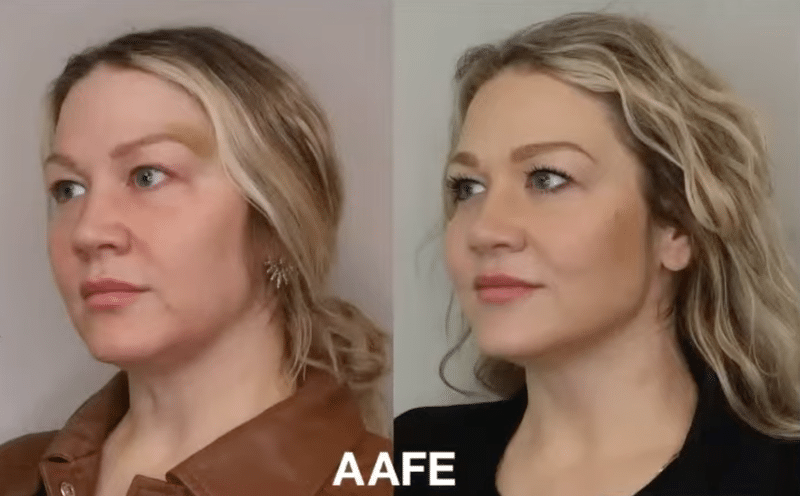
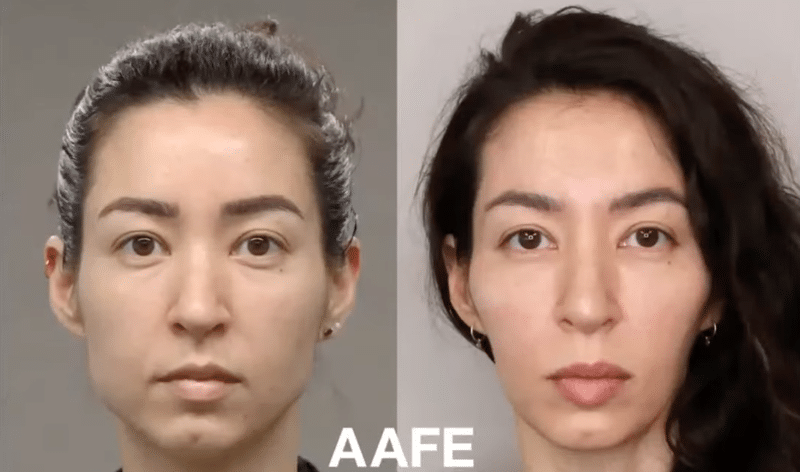
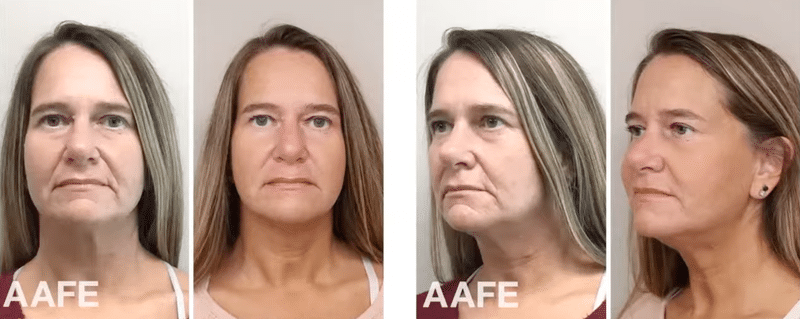
The masseter Botox before-and-after images below show how the lower face can change as the muscle gradually relaxes.
What If You Do Not See Results After 2 Weeks?
Two weeks can reveal early muscle relaxation, but it is too soon to rule out later facial slimming. Contact your provider when there is no functional change, uneven movement, troublesome chewing weakness, or unexpected symptoms.
Do not massage or overwork the area trying to make Botox work faster. Your provider may reassess muscle strength, injection placement, the original diagnosis, and whether the Botox administered matched your anatomy.
Masseter Botox for Teeth Grinding vs Jaw Slimming: Different Timelines
The same treated muscle can serve two goals, yet the milestones should never be judged on one schedule.
| Treatment Goal | First Useful Sign | Fuller Result | Best Review Point |
| Teeth grinding or jaw clenching | Less force within a few days to 2 weeks | Clearer relief around 2 to 4 weeks | Symptom diary and clench exam |
| Muscle-related TMJ symptoms | Gradual relief over 1 to 2 weeks | Depends on diagnosis and other care | Clinical reassessment, not appearance |
| Jaw slimming | Subtle change around weeks 4 to 6 | Often clearest between weeks 6 and 12 | Matched photographs and masseter exam |
For patients, these milestones help explain when relief or visible change may become easier to judge.
For licensed providers, that timing starts with accurate assessment, careful placement, suitable product selection, and appropriate follow-up. The patient timeline, therefore, becomes a practical lesson in treatment planning, safety, and honest expectation setting.
Why Provider Training Matters for Masseter Botox Results
An effective result begins with confirming that an overactive masseter actually explains the patient’s symptoms or wider lower face.
For providers using Botox around the lower face, accurate placement matters because small differences can affect chewing comfort, smile balance, and symmetry.
Timing should also be explained clearly during that assessment. Our Dr. Louis Malcmacher explains:
“You can start noticing within about five days, but full effect is at two weeks.”
— Dr. Louis Malcmacher, President, MAGD
AAFE has trained more than 18,000 dental and medical professionals through live-patient, hands-on instruction since 2007. Providers seeking practical updates on neuromodulator assessment, anatomy, safety, and patient care can join AAFE’s email list.

Frequently Asked Questions
More Information
- Exploring Botulinum Toxin’s Impact on Masseter Hypertrophy
A randomized trial following muscle thickness, electrical activity, facial prominence, and chewing performance for six months.
Botulinum toxin treatment for masseter hypertrophy - Reduction of Masseter Muscle Prominence After Treatment With OnabotulinumtoxinA: Primary Results From a Randomized Phase 2 Study
A 187-patient trial measuring lower facial volume at day 90 and treatment safety through 12 months.
OnabotulinumtoxinA for masseter muscle prominence - The Role of Botulinum Toxin for Masseter Muscle Hypertrophy
A comprehensive review covering treatment mechanisms, dosing, injection placement, clinical outcomes, complications, and long-term safety questions.
Botulinum toxin for masseter muscle hypertrophy - Facial Volume Reduction and Masticatory Function After Masseter Botulinum Toxin Injection
A prospective 24-patient study measuring facial volume and perceived chewing function at weeks four, eight, and twelve.
Facial volume changes after masseter injections - Repeated Injections of Botulinum Toxin Into the Masseter Muscle Induce Bony Changes in Human Adults
A 20-patient longitudinal study comparing one and two treatment sessions using 3D imaging taken six months after treatment.
Bony changes after repeated masseter injections