Summary
Masseter Botox can sometimes cause unwanted effects such as chewing weakness, smile asymmetry, facial hollowing, or an uneven jawline. Most complications are temporary, but careful patient assessment, precise injection placement, conservative dosing, and strong knowledge of lower-face anatomy are essential to reduce risk and manage problems appropriately.
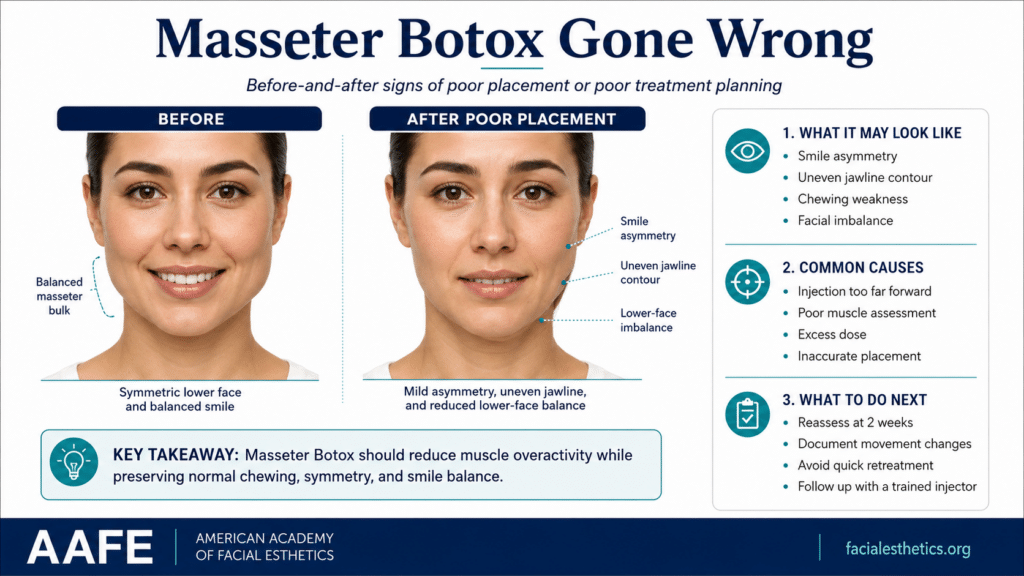
A crooked smile after masseter treatment rarely feels like a small problem once the patient is back in the chair. For an injector, masseter Botox gone wrong can mean chewing weakness, facial imbalance, bulging, or a result that changed more than expected. Most effects are temporary, but a calm response starts with clear records and a careful assessment.
What Does “Masseter Botox Gone Wrong” Usually Mean?
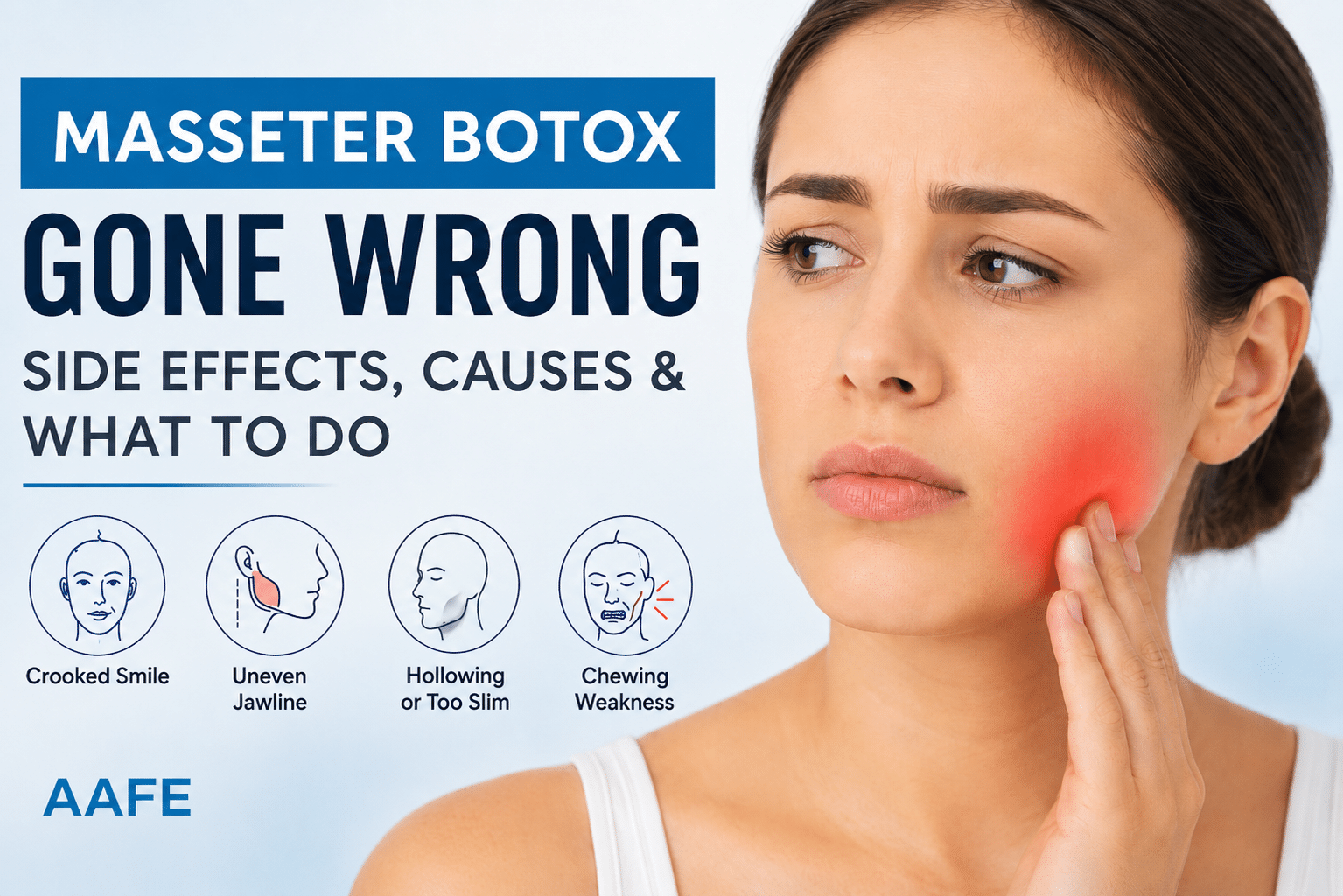
The treatment changed the patient’s appearance or jaw function in an unwanted way. Bad masseter Botox may cause chewing weakness, jaw soreness, an uneven jawline, hollow cheeks, a limited smile, or bulging during clenching. Mild bruising and tenderness can follow the injection, while breathing, swallowing, or speech problems require urgent care [8].
Important: Injection of BOTOX Cosmetic into the masseter is an off-label use in the United States because the masseter is not an FDA-approved cosmetic treatment area [8]. Consent and documentation should state that clearly.
Expected Effects vs Possible Complications
| Often mild and temporary | Needs clinical review | Urgent red flags |
| Small bruise, swelling, or tenderness for several days [1] [4] | Crooked smile or new facial asymmetry | Trouble breathing, swallowing, or speaking [8] |
| Mild soreness near an injection site | Chewing difficulty that limits meals or worsens | Generalized or worsening weakness [8] |
| Chewing fatigue with hard foods | One-sided weakness, bulging, hollowing, or jawline asymmetry | Double vision, drooling, hives, wheezing, or faintness [8] |
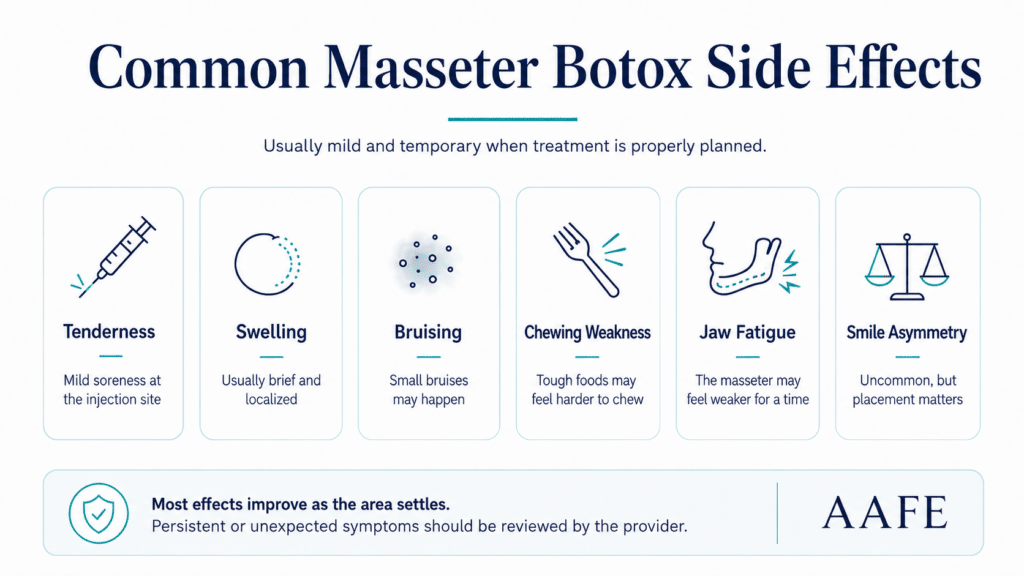
Common Masseter Botox Side Effects
Some concerns begin at the injection site, while others appear later as the masseter loses force. That timing helps guide the follow-up conversation.
Bruising, Swelling, or Tenderness
Minor bruising, swelling, and tenderness usually improve within several days [1] [4]. A wrapped cold pack may help during the first day, but growing swelling, heat, drainage, or worsening pain needs review. The chart should record the side, onset, and change over time.
Chewing Weakness
The masseter creates a large share of bite force, so some chewing fatigue can follow treatment. Across 2,036 sessions, temporary chewing-force reduction occurred after 611, or 30%, and often moved toward baseline by week 12 [1]. The injector should ask which foods are difficult, whether weakness is one-sided, and whether it is worsening.
Jaw Soreness or Tightness
Light soreness may settle within days. New or growing pain needs a fresh assessment of the bite, facial muscles, injection sites, and original goal. For muscular TMD cases, baseline pain, jaw movement, tenderness, and muscle activity should be recorded so later changes can be compared [5].
Smile Asymmetry After Masseter Botox
A crooked or limited smile can occur when toxin affects the risorius or another nearby facial-expression muscle [1] [4] [6].
Patients may say the Botox “migrated,” although local spread is usually the clearer description. Photos and short videos at rest, speaking, and smiling should be compared with pre-op records.
AAFE founder and president Dr. Louis Malcmacher is blunt about what can happen when an injection reaches the risorius:
“It will look like she’s got a Bell’s palsy”
— Dr. Louis Malcmacher, President, MAGD
Lower-face anatomy leaves little room for incorrect placement.
Why Masseter Botox Can Go Wrong
Most masseter Botox complications begin with a mismatch between the plan and the patient. Common causes include:
- Incorrect masseter Botox injection placement or depth that affects nearby muscles
- Product spread outside the intended masseter borders
- A dose that does not fit the patient’s muscle size, strength, or goal
- Treating jaw width caused mainly by bone or facial fat
- Missing baseline facial asymmetry before treatment
- Incomplete assessment of clenching, bite force, jaw pain, and smile movement
- Limited training in lower-face anatomy and complication management
When the Face Looks Too Slim or Hollow
Over-slimming happens when masseter volume falls more than the lower face can carry well. Narrow faces, low facial fat, and existing skin laxity may show more hollowing or jowling. Across 2,036 sessions, sunken cheeks followed 0.44% of treatments and sagging followed 0.20% [1].
Repeated treatment deserves extra care. Two treatment rounds produced greater muscle reduction than one in 20 adults, with measurable thinning at the mandibular angle at six months [2]. Repeat treatment also reduced muscle thickness and activity at six months, although chewing performance did not differ significantly between groups [3].
Paradoxical Bulging and an Uneven Jawline
Paradoxical bulging appears during clenching when one part of the masseter remains active while another relaxes [1] [4] [7].
It occurred after 0.49% of 2,036 treatment sessions [1]. A clenching video, palpation, and the original treatment record should be reviewed before any correction.
Pre-Op Assessment That Helps Prevent Complications
Complication care starts before the injection. A complete pre-op record gives the provider a reliable comparison if the smile, bite, or jawline later changes.
- Record the treatment goal. Jaw slimming, bruxism (teeth grinding), jaw tension, or muscular pain.
- Review health history, medicines, neuromuscular conditions, earlier toxin reactions, and recent facial treatments.
- Examine jaw width at rest and while clenching to separate muscle from bone and facial fat.
- Photograph the lower face at rest, smiling, speaking, and clenching with the same lighting and angle.
- Document baseline asymmetry, bite force concerns, chewing limits, pain, tenderness, and jaw movement.
- Record the product, lot number, dilution, amount, sites, consent, and follow-up plan.
Post-Op Care and Follow-Up
Post-op instructions should explain what is expected, when to call, and which symptoms require urgent care. The practice should provide a direct contact route and plan a review at about two weeks.
Jawline slimming may take four to eight weeks to appear, so an early cosmetic result should not trigger a rushed correction.
When a concern is reported, the team should record the injection date, symptom onset, affected side, severity, and any breathing, swallowing, speech, vision, or strength changes.
A clear before-and-after comparison should use the same angles at rest, smiling, speaking, and clenching.
How Long Can Unwanted Results Last?
Botox effects are temporary, but unwanted results do not follow one timeline. Among 223 followed adverse-event cases, improvement was confirmed after an average of 5.3 months, with a range of 13 to 667 days [6]. Soreness may clear sooner, while chewing, smile, or volume changes can last weeks or months.
How Injectors Should Respond When a Patient Calls
The first response can protect both the patient and the practice. It should be calm, specific, and documented.
- Confirm the timeline. Record the treatment date, product, amount, sites, and first symptom.
- Screen for urgent symptoms. Breathing, swallowing, speech, vision, or generalized weakness changes need immediate action [8].
- Request useful records. Ask for clear photos or video at rest, smiling, speaking, and clenching.
- Arrange the right review. Functional or worsening symptoms need earlier assessment.
- Avoid a rushed touch-up. More toxin can worsen weakness, hollowing, or asymmetry.
- Refer when needed. Problems outside the injector’s scope need the right medical, dental, or emergency provider.
When Emergency Care Is Needed
| Call 911 or send the patient to an emergency department for trouble breathing, trouble swallowing, trouble speaking, rapidly worsening facial weakness, generalized weakness, double or blurred vision, drooling or inability to manage saliva, or allergic symptoms such as hives, wheezing, facial swelling, dizziness, or fainting. Serious toxin effects can appear hours to weeks after injection [8]. |
Why Masseter Training Needs Both Anatomy and Diagnosis
The masseter shapes the jawline and drives chewing, clenching, and bite force. Weak assessment can turn a quick injection into a long follow-up problem.
Dentists already examine teeth, bite patterns, bruxism, TMJ symptoms, and facial pain. That gives them a useful base when adding masseter Botox to a practice, but focused injector training is still needed.
Dr. Malcmacher sums up the standard as
“anatomy, safety, and technique”
Anatomy guides placement, safety shapes case selection, and technique turns the plan into controlled treatment.
Scope-of-practice and supervision rules vary by state. Each clinician should confirm current board requirements before offering masseter treatment.
AAFE offers three ways to close different gaps in masseter care:
- The live Frontline TMJ and Facial Pain Therapy Level I course teaches examination, differential diagnosis, treatment planning, referral decisions, and hands-on care with model patients.
- The on-demand 3 Best Botox Magical Masseter Treatments course focuses on masseter anatomy, dosing, injection technique, smile distortion, and paradoxical bulging.
- The on-demand New Ways to Fix Bad Botox Complications course helps injectors prevent, assess, and respond to unwanted neurotoxin results.
AAFE has trained more than 18,000 dental and medical professionals through anatomy-based, live-patient facial esthetics and therapeutic education. Better preparation protects patient trust and reduces corrective visits that consume chair time.

Frequently Asked Questions
More Information
- Complications of Botulinum Toxin Injection for Masseter Hypertrophy: Incidence Rate From 2,036 Treatments and Summary of Causes and Preventions
A six-year review of complication rates, causes, and prevention across 680 patients and 2,036 treatment sessions. - Repeated Injections of Botox in the Masseter Muscle: A Longitudinal Study
A clinical summary of muscle and mandibular bone changes measured six months after one or two treatment rounds. - Exploring Botulinum Toxin’s Impact on Masseter Hypertrophy: A Randomized, Triple-Blinded Clinical Trial
A six-month trial comparing functional and structural effects after single and repeated injections. - Adverse Effects of Treating Bruxism and Masseter Muscle Hypertrophy With Botulinum Toxin Injection
A literature review covering complications, possible causes, prevention, and management. - Effects of Botulinum Toxin Type A on the Masseter Muscles of a Patient With a Temporomandibular Joint Disorder of Muscular Origin
A six-month case report using clinical measures and electromyography to track muscle activity and symptoms. - Treatment of Masseter Muscle Hypertrophy With Botulinum Toxin Type A Injection: A Review of Adverse Events
A retrospective study of 46,250 patients and 61,341 procedures that followed 223 physician-diagnosed adverse-event cases through improvement. - Masseter Hypertrophy: Toxin Treatment Techniques, Causes of Complications, and Prevention
A clinical chapter covering masseter anatomy, complication patterns, risk factors, and prevention. - BOTOX Cosmetic Important Safety Information
Official safety information on allergic reactions, distant toxin effects, and symptoms requiring urgent medical care.